
Ultra-Low Temperature Freezers
Low-temperature storage for samples, cultures, reference material and high-value technical product, in upright and chest formats.
Processing plants and laboratories buy low-temperature storage for one reason: the sample or the batch has to be in the same condition tomorrow as it is today. That requirement changes the questions a buyer should ask, and it moves the discussion away from cabinet volume.
A low-temperature cabinet is not judged by its coldest advertised figure alone. What matters in daily use is how evenly the chamber holds condition, how quickly it returns to setpoint after the door closes, and what the unit does when the room around it is warm. A cabinet that meets a setpoint in a cool, quiet room can behave differently in a processing hall or a lab without air conditioning.
The problems that repeat across processing and research projects:
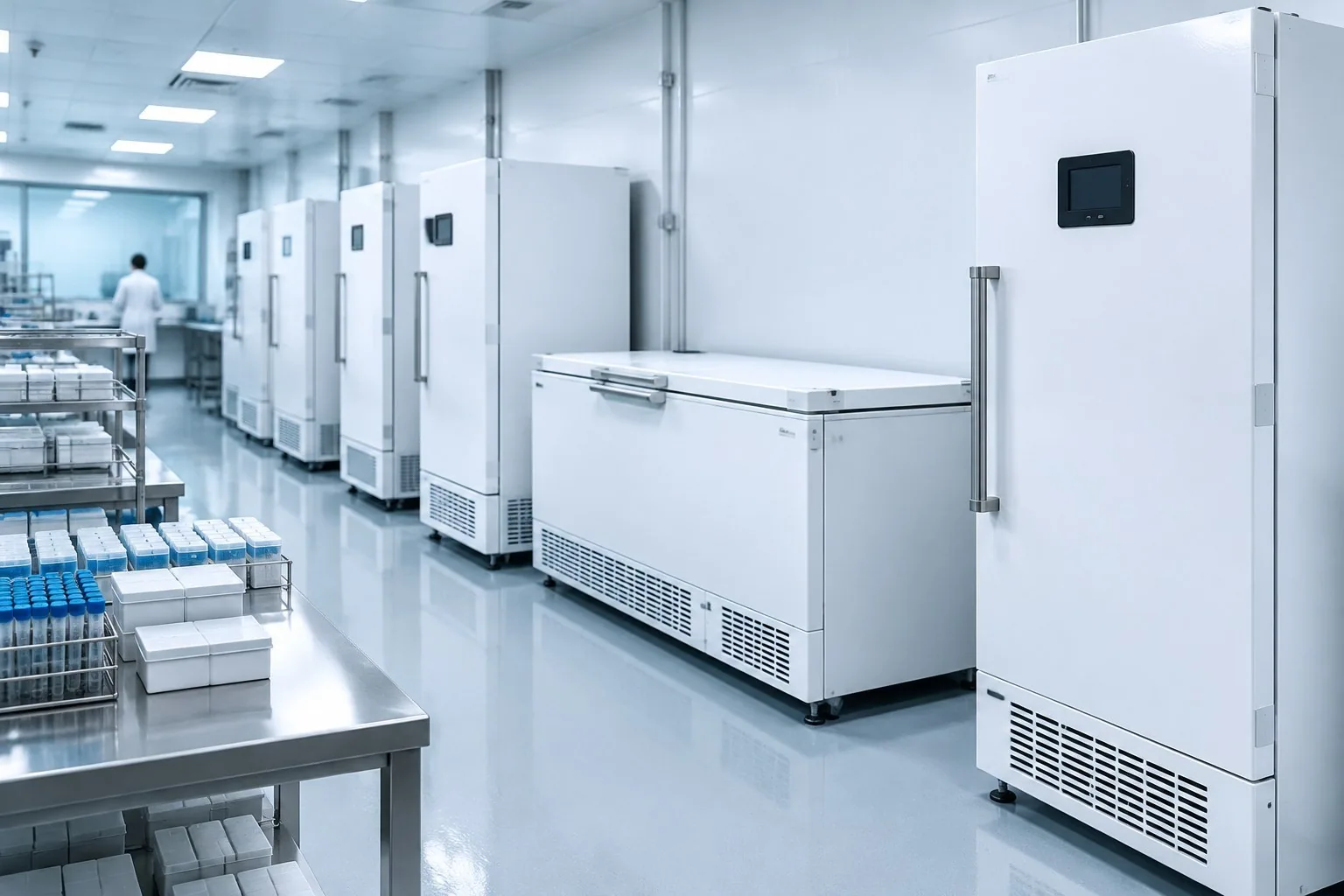
Processing and research facilities normally combine five families across production and storage:
Low-temperature storage for samples, cultures, reference material and high-value technical product, in upright and chest formats.
Rapid freezing of production batches, specified from batch weight, entry condition and process time.
Bulk chilled and frozen storage for raw material, work in progress and finished product.
Stainless work surfaces and refrigerated benches for sample handling, portioning and bench work.
Intermediate storage for ingredients, media and reagents that sit between ambient and low-temperature storage.
In technical storage, the parameters below are the specification. Confirm each one in writing against the exact model under consideration.
| Target storage temperature | Set by the material being stored. Ultra-low storage commonly sits in the minus 40 degrees Celsius and below band; the achievable range and stability are confirmed per model. |
|---|---|
| Uniformity across the chamber | Difference between the coldest and warmest usable position. Ask how the figure was measured and at what load. |
| Recovery after door opening | Time to return to setpoint after a defined opening. This drives sample condition in a busy laboratory more than the setpoint does. |
| Ambient design condition | The temperature of the room the unit stands in, and where the rejected heat goes. Both are site facts confirmed per project. |
| Format and internal layout | Upright or chest, shelf and rack arrangement, and access height for the people who use it daily. |
| Alarm and monitoring | Alarm contacts, remote monitoring and data logging availability vary by model and are confirmed per project. |
| Power supply and backup | Voltage, frequency, phase, circuit protection and the site plan for power interruption. |
| Documentation and service | Datasheet, drawings, manual, spare-parts list and the maintenance arrangement. Documentation scope is confirmed per project. |
Send the material or product stored, the required storage temperature and stability, the expected daily access frequency, the chamber format you prefer, the measured ambient of the room, the heat rejection path, the utilities and the monitoring requirement. For production freezing, add batch weight, entry temperature and the process window. For documentation, state which records the project needs so the available scope can be confirmed early.
SHEHOPE is based in Foshan, Guangdong, China, and works through a shared manufacturing system with more than 20 years of experience, a 20,000 m² production facility, more than ten production lines, an annual capacity of approximately 50,000 units and an ISO 9001 quality system. OEM and ODM projects can cover voltage and plug configuration, interior layout and logo marking, with the final electrical configuration confirmed per model and market. Typical production planning runs 20-30 days, and warranty terms are confirmed per project.
Low-temperature storage for samples, reference material and technical product in upright and chest formats.
Rapid freezing of production batches, specified from batch weight, entry condition and process time.
Bulk chilled and frozen storage for raw material, work in progress and finished product.
Stainless and refrigerated bench surfaces for sample handling, portioning and bench work.
Intermediate storage for ingredients, media and reagents held between ambient and low-temperature conditions.
A blast freezer is a process unit. It is specified to move a batch through the freezing range within a defined time, from a stated entry condition. An ultra-low-temperature freezer is a storage unit. It holds material at a low setpoint over long periods. One is sized by batch and process time, the other by storage volume and access pattern.
Decide with the storage plan. Upright cabinets organize samples on shelves and are easier to search, which reduces door-open time over a working day. Chest formats expose less of the chamber when opened and suit bulk storage of similar items. Usable internal arrangement is confirmed per model.
Ask how the uniformity figure is defined across the usable chamber, at what load and ambient it was measured, and how long the unit takes to return to setpoint after a defined door opening. Performance figures are confirmed per model, because chamber size, format and refrigeration arrangement all change the result.
OEM projects can cover market-specific voltage and plug configurations and customized interior layout. Alarm contacts, remote monitoring and data logging availability vary by model. The final electrical configuration depends on the model and the applicable market approval, so both are confirmed per project.
Datasheet, dimension drawings, electrical data, refrigerant information, manual and spare-parts list are the standard set for review. Test records and certificate files depend on the model and the destination market, so the documentation scope is confirmed per project before it is relied on.
Send the layout, menu or product mix, target temperatures and site conditions. We reply with the equipment list and the questions that still need answers.