
Precision sheet-metal cutting
Stainless-steel and panel parts are cut by CNC laser, which holds dimensions and keeps the fit repeatable from the first unit to the last in a run.
Quality is only meaningful when it is attached to an inspection item, a condition, an acceptance limit and a record. This page describes the production controls, the inspection stages and the documents that can travel with a commercial refrigeration order.

Four process stages carry most of the product quality in commercial refrigeration. The production plan itself is specific to the product family, the order configuration and the approved specification.
Stainless-steel and panel parts are cut by CNC laser, which holds dimensions and keeps the fit repeatable from the first unit to the last in a run.
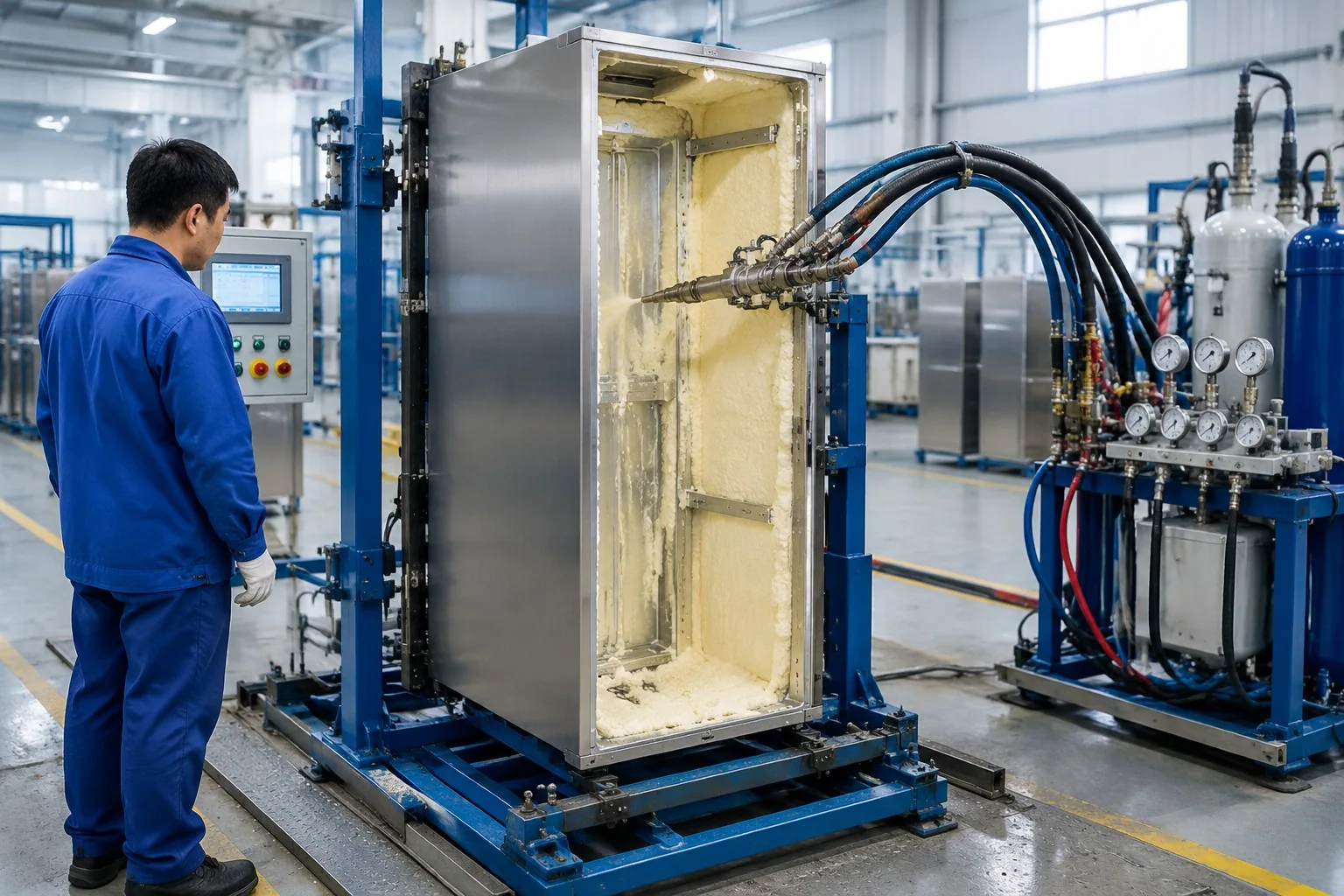
Panel structures use high-pressure polyurethane integral foaming for insulation. Foam density and cavity filling are process parameters rather than finishing details; they drive temperature performance and cabinet rigidity.
Approved units are assembled on a standardized production line, so wiring routing, refrigeration circuit assembly and fittings follow one defined method instead of individual practice.
Finished equipment can use export-grade fumigation-free wooden pallet packing, with the final packing specification agreed by product family, quantity and route.
Process control means the settings that matter are defined before the run starts: cutting programs, foaming parameters, the assembly method and the packing specification. They belong to the order file rather than to decisions taken on the line, which is what makes results repeatable across a production run instead of dependent on who is working that day. The shared facility operates under an ISO 9001 quality management system, which governs how requirements, processes and records are controlled; it is a management-system certification and is separate from the model-level product certificates discussed further down this page.

Inspection is organized as stages, and each stage is recorded against the order specification. The exact inspection plan depends on the product family and the configuration being built.
| Incoming material | Material, component and supplier records are checked against the order specification before parts enter production. |
|---|---|
| In-process | Dimensions, panel fit, insulation work and cabinet assembly are checked as the unit moves along the line, before the unit is closed up. |
| Electrical and refrigeration | Wiring, earthing, refrigerant circuit integrity and leak checks are carried out for the applicable model and market configuration. |
| Performance | Temperature and operating behavior are checked under stated conditions, with the test condition recorded alongside the result. |
| Final inspection | Appearance, function, labeling, accessories and documentation are verified before the unit is released for packing. |
| Packing | Protection, marks, dimensions, weight and shipment release documents are confirmed against the order. |
Two principles apply across all six stages. First, an inspection result is only useful when the condition and the acceptance limit are recorded with it, so the inspection plan is written before the run and not reconstructed afterwards. Second, the inspection references the approved order specification, which means a change of model, electrical build or interior layout also changes what has to be checked. Inspection records are kept against the order so that a question raised weeks after delivery can be traced back to the unit that was built and shipped.

The pre-shipment stage is the last point where a deviation can be corrected before the order leaves the facility. Units are checked against the approved specification: model and configuration version, electrical build, control settings, labeling and artwork, accessories, and the documents that must accompany the shipment. Packing is verified for protection and for marking, including pallet marks and handling instructions. Where a buyer appoints a third-party inspection agency, the inspection can be arranged before release; the check items, sample size and acceptance criteria are agreed in advance, because an inspection without agreed criteria produces an opinion rather than a release decision.

The shared manufacturing system supports CE, CB and RoHS documentation according to the applicable model and destination market. This is a position about documentation scope, not a blanket statement that every unit in the catalog is certified for every country, so send the destination market and the model being quoted and the applicable certificate type, issuer, validity and model coverage will be confirmed in writing. Technical files such as specification sheets, manuals and parts lists are issued against the confirmed model. Where a market, project specification or tender requires a document that is not already held, the requirement should be raised at quotation stage so the scope, responsible party and timing can be reviewed before production.
Quality claims that are not tied to a model, a test condition and an acceptance limit are not useful to a buyer. Aging-test hours, failure rates, component brand lists, in-house laboratory approvals and inspection pass statistics are confirmed against the order specification when a buyer needs them written in — they are not published as generic catalogue claims. If a buyer needs a specific acceptance criterion, test condition or inspection item written into the order, send it with the inquiry and it can be included in the specification instead of assumed.
The shared manufacturing system supports CE, CB and RoHS documentation according to the applicable model and destination market. Certificate type, number, issuer, validity and applicable models are confirmed per project, so please send the destination market and the model being considered and the applicable certificate set and scope will be confirmed.
Appearance, function, electrical and refrigeration checks for the applicable model, labeling and artwork, accessories, documentation, packing protection and shipment marks. The checks are made against the approved specification for that order, and the inspection items depend on the product family and configuration.
Yes. Where the buyer appoints an inspection agency, the inspection can be arranged before the shipment is released. The check items, sample size and acceptance criteria are agreed in advance so the inspection produces a release decision against recorded limits.
Send the criteria with the inquiry. Test conditions, temperature requirements, tolerances and inspection items that matter for your market can be written into the order specification, and inspection is then recorded against that specification.
Technical files such as specification sheets, manuals and parts lists are issued against the confirmed model, and inspection is recorded against the approved specification. Test records and certificates that apply to your market and model are confirmed at quotation stage, so send the document list your market or project requires.
Share the food or product being stored, target temperature, ambient conditions, available space, voltage, quantity and destination market.