
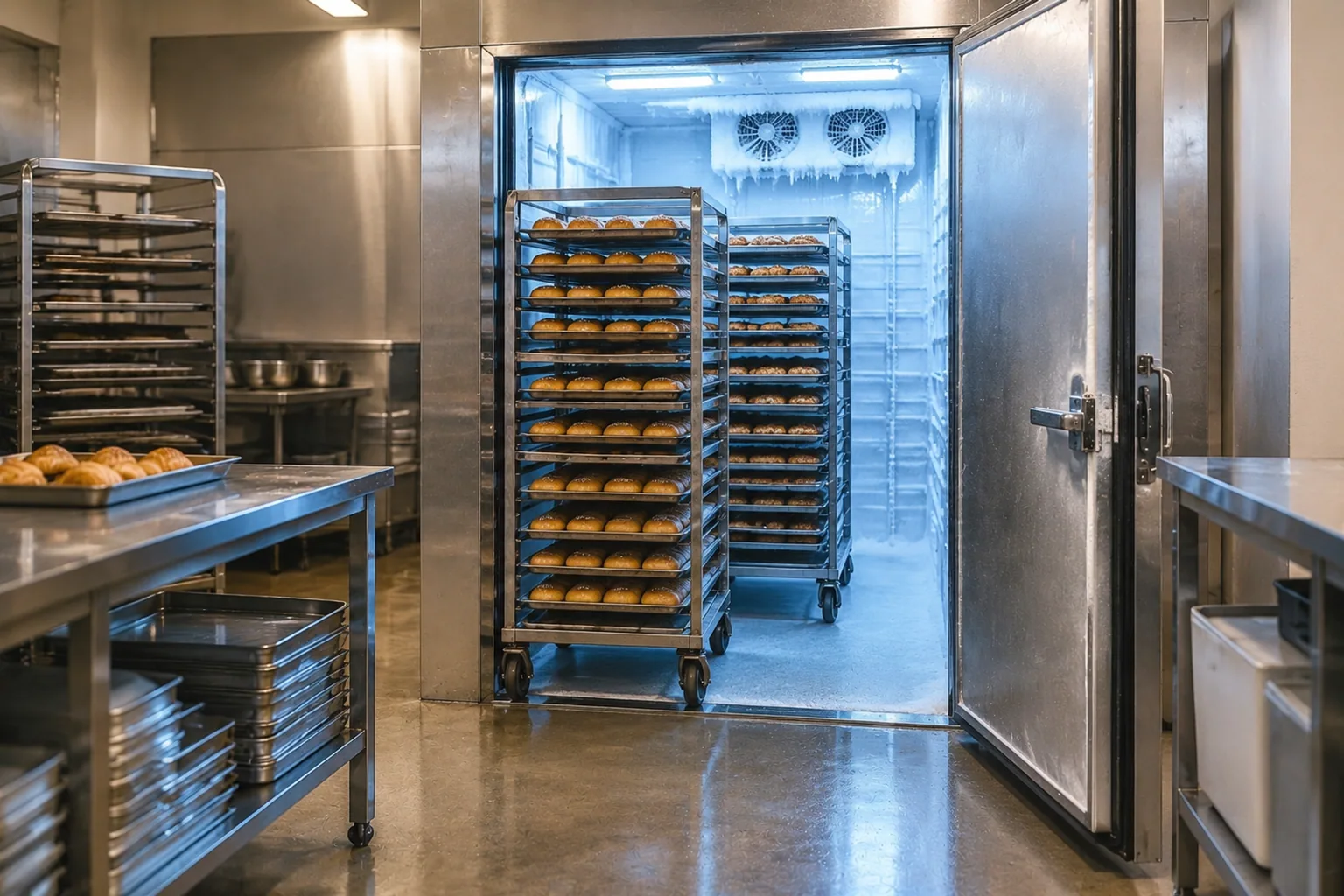
Blast freezers
Rapid freezing after shaping, filling or part-baking, selected around batch weight, entry condition and the process time the schedule allows.
Bakery refrigeration is a process problem before it is an equipment problem. Dough, laminated pastry, cream fillings and finished cakes each need a different holding condition, and the cabinet that suits one of them will not automatically suit another.
Most bakery refrigeration problems begin in the production room, not inside the cabinet. Ovens and hot equipment raise the local ambient temperature, so a unit selected from a mild-room assumption works harder for every hour of the shift. Pull-down slows, defrost cycles take longer, and the cabinet spends more of the day recovering instead of holding.
Three further pressures repeat across bakery projects:
Bakery refrigeration rarely comes from one family. The usual map covers six duties:
Rapid freezing after shaping, filling or part-baking, selected around batch weight, entry condition and the process time the schedule allows.
Bakery tray cabinets and reach-in storage for chilled dough, fillings and frozen stock. Tray slides, door type and defrost method matter more than headline volume.
Refrigerated work surfaces at dough and cream assembly height, so ingredients stay in condition while the bench is in use.
Front-of-house presentation for whole cakes, slices and desserts, including floor-standing formats where the sales area has the footprint for them.
Short-run pastry and dessert counters where depth is limited and product turns over quickly during trading hours.
Frozen finished product and take-home items that need visibility without opening the cabinet to a warm sales floor.
These are the inputs that change the recommended configuration. Send them as measured and written values, not as an approximate memory of the room.
| Tray and pan format | Slide spacing, shelf depth and usable height follow the tray the bakery actually uses. Confirm the format before comparing capacities. |
|---|---|
| Product condition on entry | Warm dough, chilled dough and frozen part-baked product place different loads on the evaporator and change the required pull-down. |
| Batch load per cycle | Kilograms per batch, not cabinet volume, set the freezing or chilling duty. Weigh a representative batch. |
| Production room ambient | Declared performance is normally stated at a defined ambient temperature. Give the measured condition at the intended cabinet position, at the busiest hour. |
| Defrost method and timing | Automatic defrost is common, but the schedule has to fit the production window. Method and recovery behaviour are confirmed per model. |
| Access and door type | Solid doors, glass doors and drawer sections change how much cold air leaves the cabinet each time staff load or unload it. |
| Display condition | Cream, chocolate and ambient-stable products do not share one holding condition. Display temperature and glass treatment are confirmed per model and per product plan. |
| Utilities and drainage | Voltage, frequency, phase, drainage route and ventilation clearance are site facts, confirmed per project. |
A short, specific brief shortens technical review. Send the tray or pan format, the product condition on entry, the batch weight, the measured ambient at the cabinet position, the footprint and access route, the utilities, and the destination market with its documentation requirement.
SHEHOPE is based in Foshan, Guangdong, China, and works through a shared manufacturing system with more than 20 years of experience, a 20,000 m² production facility, more than ten production lines, an annual capacity of approximately 50,000 units and an ISO 9001 quality system. Typical production planning runs 20-30 days, confirmed by model, quantity, season and customization scope. OEM and ODM projects can cover voltage, plug, interior layout and logo marking, with the final electrical configuration confirmed per model and market. Warranty terms are confirmed per project.
For rapid freezing of shaped dough, fillings and part-baked product where batch weight and process time drive the selection.
Tray-format cabinets and reach-in storage for chilled dough, fillings and frozen bake-off stock.
Refrigerated assembly surfaces that keep dough and cream ingredients in condition at working height.
Front-of-house presentation of cakes, slices and desserts, including floor-standing formats.
Compact pastry and dessert counters where depth is limited and turnover is fast.
Visible frozen storage for take-home and packaged frozen bakery items.
They do different jobs. A blast freezer is specified around a batch, an entry condition and a process time, so it can move product through the freezing range quickly. A conventional bakery freezer holds product that is already frozen. Asking one cabinet to do both normally means compromising one of the two duties, so confirm the intended duty before comparing models.
Not in the same compartment. Dough retarding and frozen storage sit in different temperature bands, and a dual-duty expectation changes the defrost strategy and the recovery requirement. If both duties are needed, plan them as separate cabinets or confirm a dual-temperature configuration per model.
List the tray or pan format, the number of trays per batch and the tray pitch you need, then add the trays in transit and in the display case. Send that list rather than a volume figure. Usable tray count is confirmed per model, because slide spacing and door configuration change it.
It depends on the product plan. Fresh cream, ganache and ambient-stable items do not share one holding condition, and a case run colder than the product needs can dry out or mark the surface. Display temperature range and glass treatment are confirmed per model and per product mix.
Ask for the datasheet, dimension drawing, electrical data, refrigerant information, manual and spare-parts list, plus the certificate files that apply to the exact model and destination market. Certificate coverage is confirmed per model and market, and warranty terms are confirmed per project.
Send the layout, menu or product mix, target temperatures and site conditions. We reply with the equipment list and the questions that still need answers.