
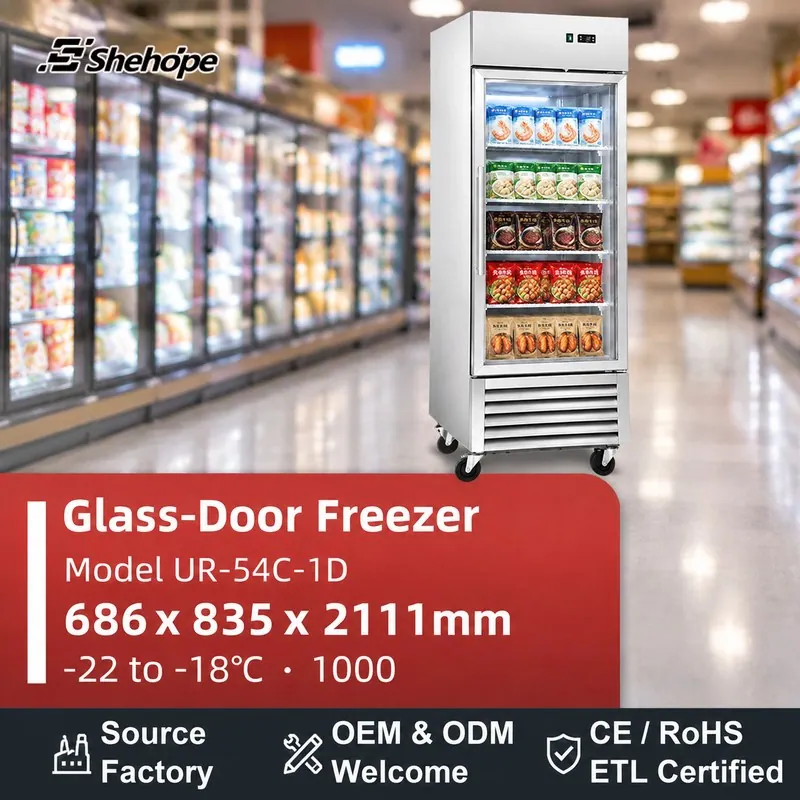
Glass-door display freezers for frozen retail
Glass-door display freezers combine frozen storage with self-service merchandising: the shopper sees the product, and the cabinet holds it behind a glass door that has to stay clear of condensation. This family covers single, double and triple door upright formats. Door opening frequency, product load and store humidity drive the configuration more than volume alone.
Typical use
- Supermarket and grocery frozen aisles for packaged frozen food.
- Convenience and forecourt retail selling ice cream and frozen snacks.
- Ice cream parlours and dessert shops displaying take-home packs.
- Hotel, restaurant and catering front-of-house frozen retail displays.
- Distributor and wholesale showrooms that display a frozen range to trade buyers.
- Seasonal promotions where frozen product needs a temporary self-service position.
Confirm before ordering
- Door count, glass specification and hinge side
- Anti-condensation glass arrangement
- Usable volume, shelf count and shelf pitch
- Product envelope and load line
- Defrost method and condensate handling
- Ambient class and installation position
- Voltage, frequency and plug configuration
- Refrigerant and market compliance documents
Configurations we build in this family
Drawn from our own product catalogue. Final specification is confirmed per model and destination market.
| Door / drawer formats | single door, double door |
|---|---|
| Catalogue items in this family | 3 (configuration confirmed per project) |
Model range at a glance
Every model in this family, sorted by size. Prices are FOB reference prices from our current listings.
| Model | Temperature range | Doors | Voltage | Reference price |
|---|---|---|---|---|
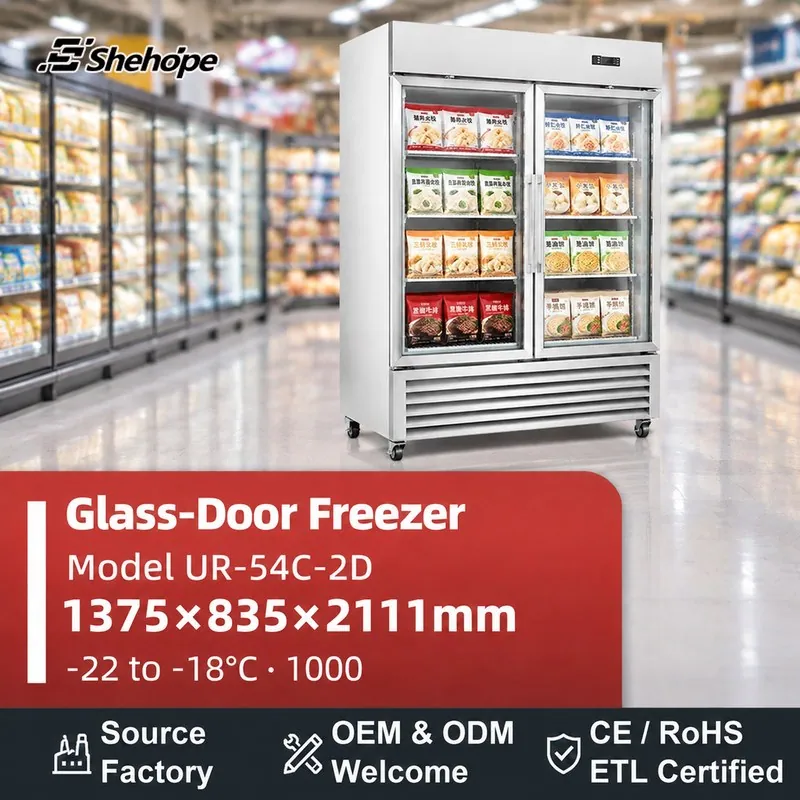
| UR-54C-2D | -18°C To -22°C | Double Doors | 110-120V (Single-Phase) | from US$1,470 |
| UR-54C-1D | -18°C To -22°C | Single Door | 110-120V (Single-Phase) | from US$696 |
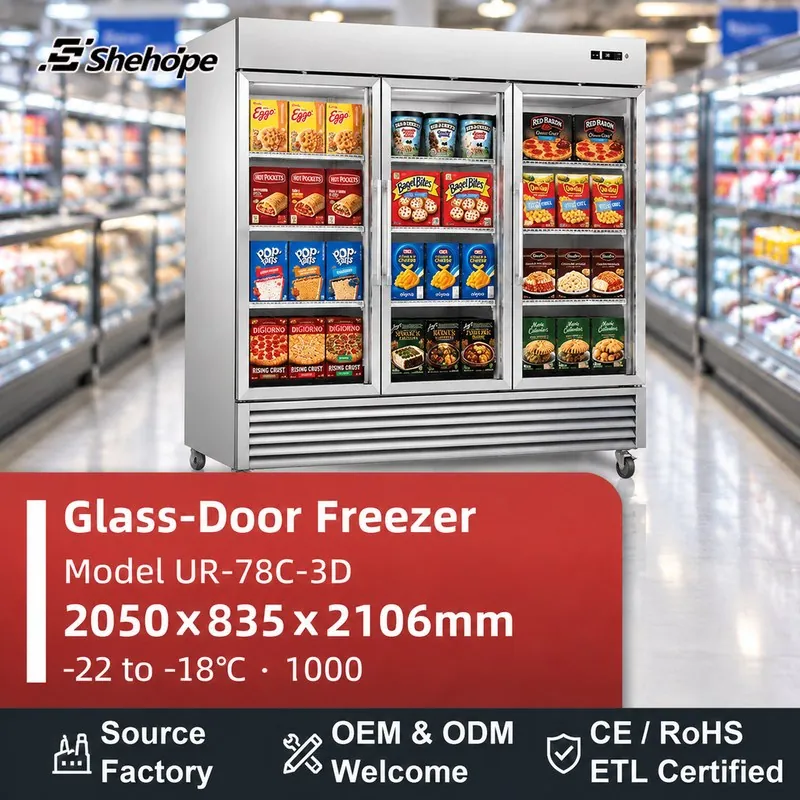
| UR-78C-3D | -18°C To -22°C | Triple Doors | 110-120V (Single-Phase) | from US$1,536 |
The highlighted row is this page. Confirm the configuration, voltage and documents for your market in the quotation.
Catalogue items in this family
3 catalogue items photographed for this family.
How this family is configured
Door count, glass specification and condensation control
The glass door is the part shoppers touch and the part that most often causes complaints, so specify it deliberately. Confirm whether the door is heated or fitted with an anti-condensation arrangement, because a frozen cabinet in a humid store will fog or sweat without it. Ask about the frame material and how the glass is cleaned, since cleaning chemicals and repeated wiping affect the coating over time. Door count follows the range and the aisle: fewer, wider doors expose more cold air each time they open, while more doors hold temperature better during trading but add frame area and reduce the usable width inside. Confirm the hinge side and whether doors self-close. Check the gasket material and how it is replaced, because a tired gasket shows up first as frost along the frame. Door arrangement, glass specification and anti-condensation measures are confirmed per model and per store conditions.
Shelf format and product envelope
Frozen retail packaging varies widely, so start from the boxes rather than from the shelf count. Confirm the tallest and deepest pack, and whether product stands or lies flat, then set shelf pitch accordingly. Ask how many shelf positions the cabinet offers and whether shelves adjust without tools, because a frozen range changes by season. The load line matters even more in a freezer: product stacked above it interrupts the air path, and the front of the shelf and the top row warm first. Confirm the load the shelves are designed to carry when the cabinet is fully stocked, and whether the base of the cabinet is used for crates. Plan how staff face up the display during the day, since frozen packaging hides the product behind it and staff tend to push items forward. Shelf pitch, load line and usable volume are confirmed per model and should be matched against the range plan.
Cooling format, defrost and recovery
Ask how the cabinet circulates air and how defrost is managed, because ice build-up is the failure mode that shortens a freezer's working life. Confirm the defrost method, how often it runs, and whether it pauses sales performance briefly or runs outside trading hours. Melt water needs a path to a drain or an evaporation tray, and that tray has to be reachable for cleaning; blocked drainage shows up as ice on the cabinet floor. Check how the cabinet recovers after a full restock, especially if staff load warm delivery stock straight into the display. In humid stores, condensation and frost load increase, so state the store humidity and the position of the case relative to entrance doors. Recovery performance, defrost strategy and the achievable holding condition are confirmed against the selected model, the ambient conditions and the loading pattern.
Placement, service access and market configuration
Placement decides how hard the cabinet works. Keep the case away from entrance doors, direct sun and heating outlets, and leave the clearance the manufacturer requires for heat rejection. Confirm whether the condensing unit is integral or remote, because a remote system moves heat and noise out of the sales floor but needs plant space and pipe runs. Service access should be possible without emptying the cabinet: confirm which panels open, where the controller sits, and how a technician reaches the coil and defrost parts. Interior LED lighting affects how packaging reads and adds heat inside the cabinet, so ask which lighting is fitted. Custom logo marking by silk screen or laser engraving can be included in an OEM project, and market-specific voltage and plug configurations are confirmed per project. Compliance documents are confirmed per model and destination market, and warranty terms are confirmed per project.
Questions we ask before quoting
- What frozen products go on display, and what is the tallest and deepest pack size?
- How many facings and shelf levels are needed?
- How often do shoppers open the doors during trading hours?
- What is the store ambient temperature and humidity at that position?
- Is the case near entrance doors, direct sun or a heating outlet?
- Is the condensing unit integral, or should it be remote?
- Is interior lighting or branding required inside the cabinet?
- Which voltage, frequency and plug type does the destination market use?
Frequently asked questions
Why does the glass door fog or sweat?
Condensation on a frozen cabinet usually comes from store humidity, a worn gasket or a position near doors and drafts. Anti-condensation or heated glass reduces it, and the gasket should be checked as part of routine maintenance. Store conditions at the installation position belong in the specification.
How is a display freezer different from a storage freezer?
A display freezer is built around visibility and frequent door opening, so it is designed to recover quickly and to present product on shelves. A storage or bulk freezer is optimized for holding volume with less attention to presentation. Where both duties exist, they are usually handled by different cabinets.
What temperature does a glass-door display freezer hold?
The holding condition is confirmed against the selected model, the ambient class, the product load and the opening frequency. Family-level figures are not published, because a freezer opened continuously during peak trading behaves differently from one opened a few times a day.
Can the freezer be branded and configured for our market?
Logo marking by silk screen or laser engraving, interior layout and finish options can be covered in an OEM project, together with market-specific voltage and plug configuration. Compliance documents are confirmed per model and destination market, and warranty terms are confirmed per project.
Send the application and we confirm the model
Share the food or product being stored, target temperature, ambient conditions, available space, voltage, quantity and destination market.