
Island Display Freezers
Walk-around frozen display where shoppers browse from both sides of the aisle.
A full grocery store runs several refrigeration duties at once. Open aisles sell packaged chilled and frozen product, glass doors hold the frozen range, and service counters cut, portion and present fresh food to order. Each duty loads the equipment differently.
Supermarket refrigeration is judged by trading hours, not by a test room. Fixtures stand in a sales floor with entrance doors, trolley traffic and air conditioning, and that environment decides more about cabinet behaviour than the fixture list does.
The pressures that repeat in supermarket and hypermarket projects:
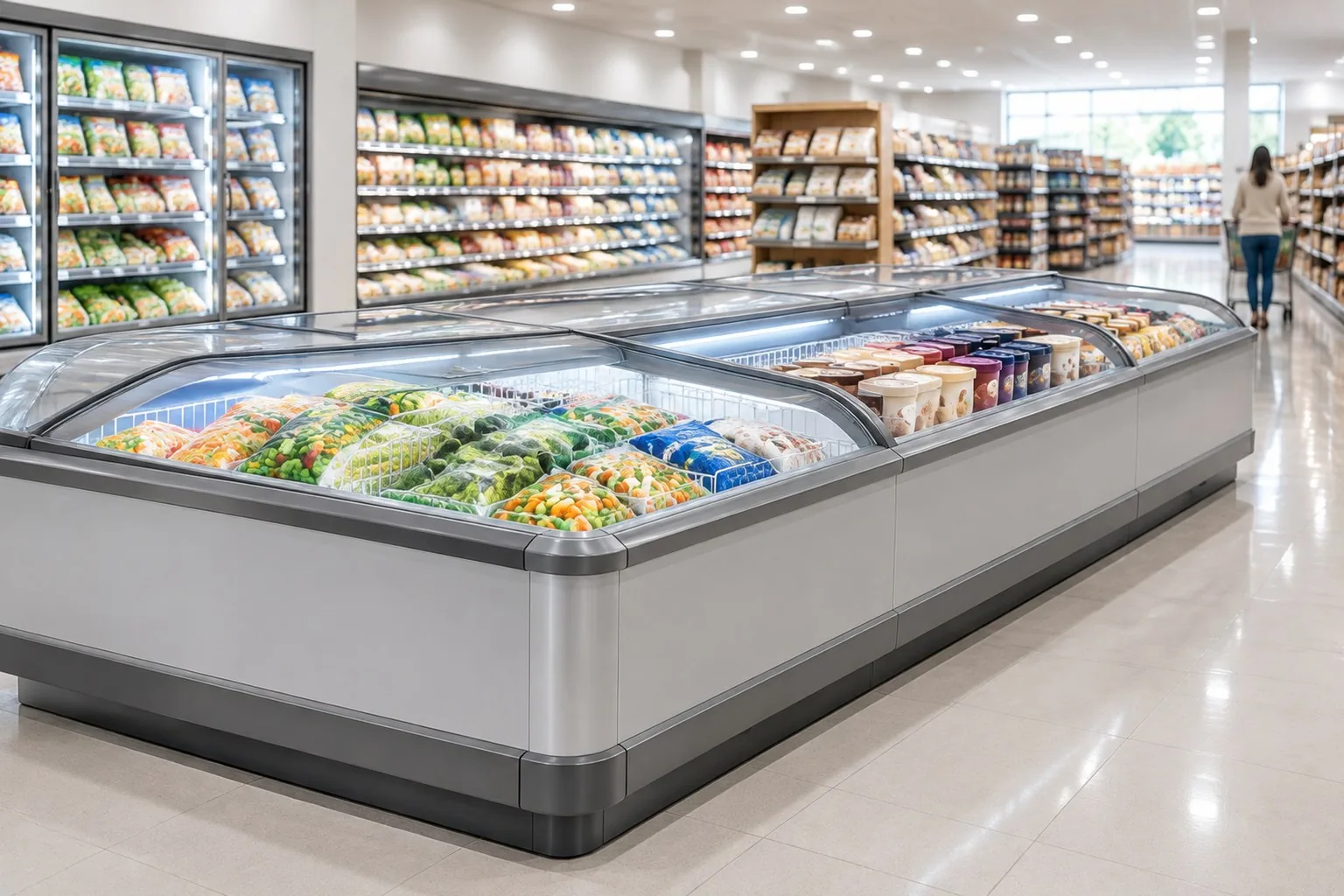
A supermarket typically combines six families, each with a defined sales role:
Walk-around frozen display where shoppers browse from both sides of the aisle.
Open-front multidecks for chilled aisles where visibility and access drive the sale, with the load line respected.
Visible frozen storage for packaged frozen ranges where the door contains the load.
Service-counter and wall cases for delicatessen, cheese and prepared food sold over the counter.
Glass-door drink coolers for chiller aisles, checkout zones and food-to-go positions.
Back-of-house chilled and frozen storage, sized from delivery frequency and daily throughput.
In-store bakery and patisserie display at counter height, where customers choose from the case.
Supermarket buyers usually compare fixtures on length and price first. These are the parameters that separate two similar-looking cabinets.
| Measured ambient at the fixture | Declared performance is stated at a defined ambient condition. Give the temperature at the fixture position during the warmest trading period, and state whether the area is air conditioned. |
|---|---|
| Planogram and load line | Shelf count, shelf pitch and the load line are confirmed per model. Product stacked above the load line interrupts the air curtain on an open fixture. |
| Aisle and circulation width | Trolley passing, replenishment cages and cleaning access set the maximum fixture depth and the service clearance behind it. |
| Service counter format | Counter length, glass profile, rear access and the amount of product cut to order define the case, not the aisle it faces. |
| Frozen display format | Island, well, glass-lid and glass-door fixtures hold condition differently and suit different shopping patterns. |
| Defrost method and schedule | Method and cycle timing are confirmed per model, then aligned with trading hours so recovery happens outside peak periods. |
| Utilities and drainage | Voltage, frequency, phase, condensate disposal and ventilation clearance are site facts, confirmed per project. |
| Market documentation | The destination market, refrigerant requirement and documentation package are confirmed per model and country. |
Send the store format and floor plan, the fixture schedule with positions, the category list with the product held in each cabinet, the measured summer ambient at each position, the entrance and air-conditioning arrangement, the planogram or shelf-pitch requirement, the utilities and drainage route, and the destination market. Adding trading hours and delivery frequency helps align defrost scheduling and back-room sizing with the store pattern.
SHEHOPE is based in Foshan, Guangdong, China, and works through a shared manufacturing system with more than 20 years of experience, a 20,000 m² production facility, four production lines, an annual capacity of approximately 50,000 units and an ISO 9001 quality system. OEM and ODM projects can cover voltage and plug configuration, interior layout and logo marking, with the final electrical configuration confirmed per model and market. Typical production planning runs 15-30 days, and warranty terms are confirmed per project.
Walk-around frozen display that lets shoppers browse the range from both sides of the aisle.
Open-front multidecks for chilled aisles where visibility and access carry the sale.
Frozen display with a door between the load and the sales floor for packaged frozen ranges.
Service-counter and wall cases for delicatessen, cheese and prepared food sold over the counter.
Glass-door drink coolers for chiller aisles, checkout zones and food-to-go positions.
Back-of-house chilled and frozen storage so display fixtures stay on display duty.
In-store bakery and patisserie presentation where customers choose from the case.
Decide category by category. Open multidecks sell through visibility and easy access, and they depend on store ambient and loading discipline. Glass-door cabinets contain the load and tolerate a warmer or draughtier sales floor better. Most stores use both, and the split follows the product and the shopping pattern rather than the fixture line.
The duties are the same, at a larger scale. A hypermarket usually has longer aisles, more entrance traffic and a bigger service-counter offer, so ambient at the fixture and circulation width matter more. Measure the sales floor during the warmest trading period instead of using one figure for the whole store.
An island display freezer supports walk-around browsing and suits a range customers like to compare side by side. A glass-door freezer contains the load and is normally easier to hold at condition under heavy opening. Many stores run both, with the split set by category and by how often the fixture is opened.
Plan back-room capacity from delivery frequency, daily throughput and the carton volume of a normal delivery, not from the sales floor area. If replenishment stock has nowhere else to go, it ends up stacked in the display fixtures, which is where most air-curtain and load-line problems start.
Ask for the datasheet with the declared ambient condition, dimension and electrical drawings, refrigerant information, load line guidance, manual and spare-parts list. Certificate files, refrigerant options and market documentation are confirmed per model and destination market, and warranty terms are confirmed per project.
Send the layout, menu or product mix, target temperatures and site conditions. We reply with the equipment list and the questions that still need answers.