

Island display freezers for frozen retail display
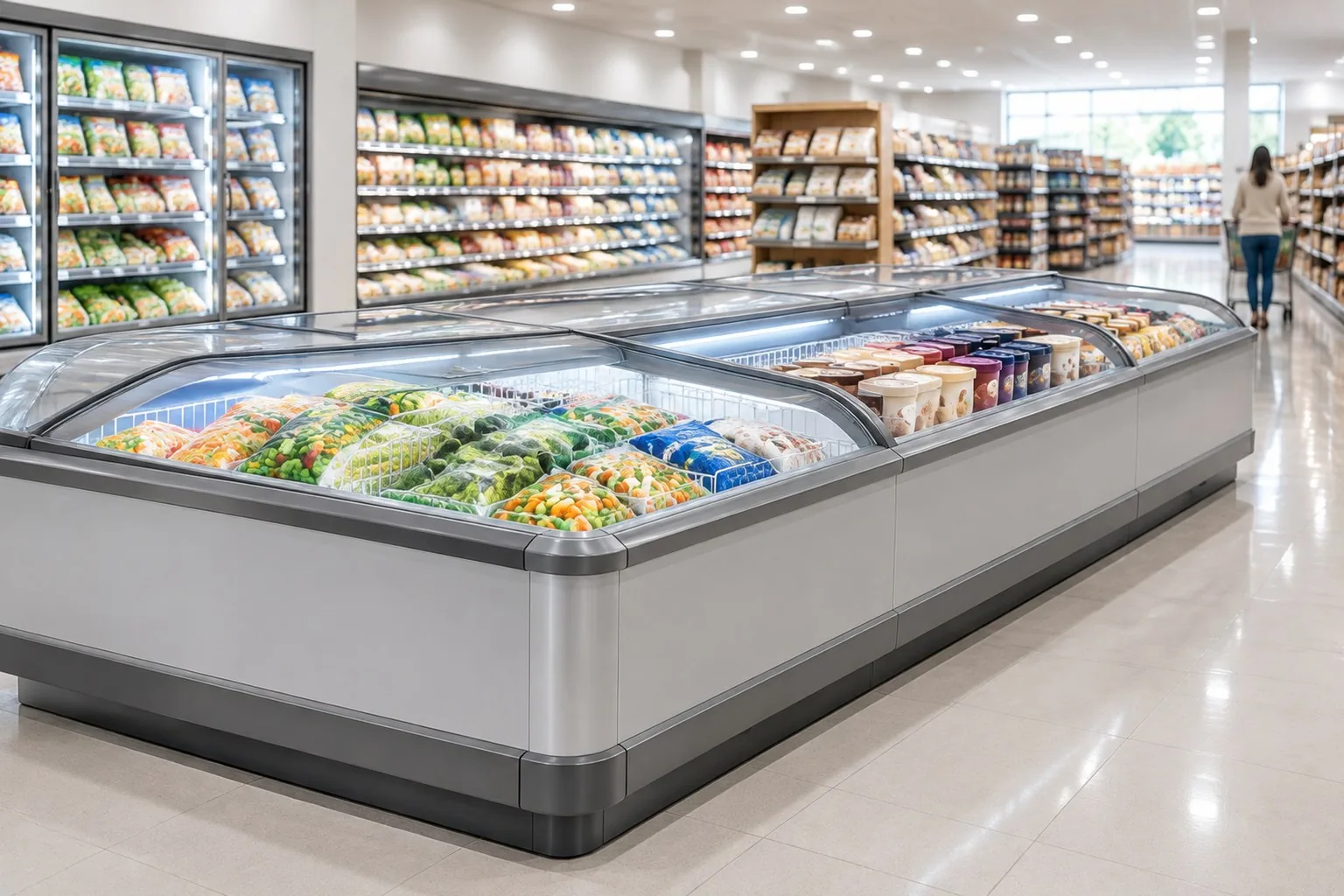
An island display freezer is a low chest that customers walk around and reach into from above, so it uses the middle of an aisle instead of a wall. This family covers straight cabinets and end cabinets with sliding glass lids and drawers, sized from about 1.5 m to 2.5 m. Length, drawer layout and how the run is closed at the end are the decisions that shape the order.
Typical use
- Supermarket and hypermarket frozen aisles where customers self-serve from an open walk-around display.
- Convenience stores showing frozen ready meals, desserts and ice cream within a short aisle.
- Frozen food shops that build a run of island cabinets from straight and end units.
- Butchers and fishmongers displaying frozen lines beside a service counter.
- Cash-and-carry and wholesale floors where frozen stock is browsed before purchase.
- Retail formats that need frozen display without a glass-door wall cabinet.
Confirm before ordering
- Cabinet type (straight run or end cabinet)
- Overall length, depth and height
- Lid arrangement (sliding, half-length, hinged) and glazing
- Drawer, basket and divider layout
- Temperature range and defrost method
- Voltage, frequency and plug configuration
- Refrigerant and market compliance documents
- Store ambient temperature and humidity
Configurations we build in this family
Drawn from our own product catalogue. Final specification is confirmed per model and destination market.
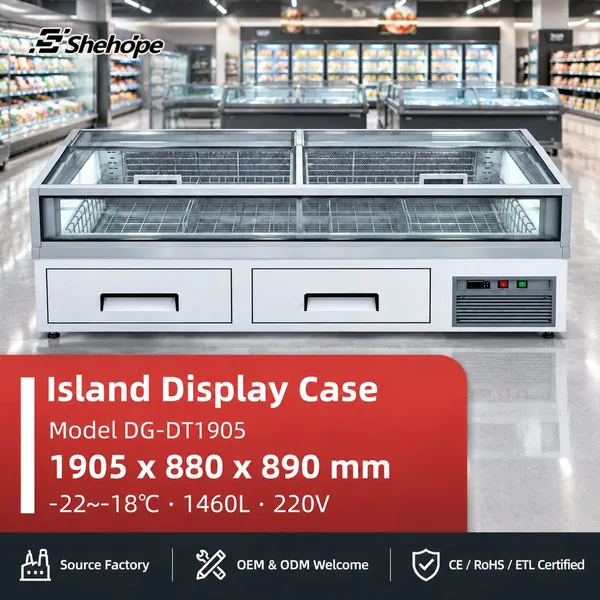
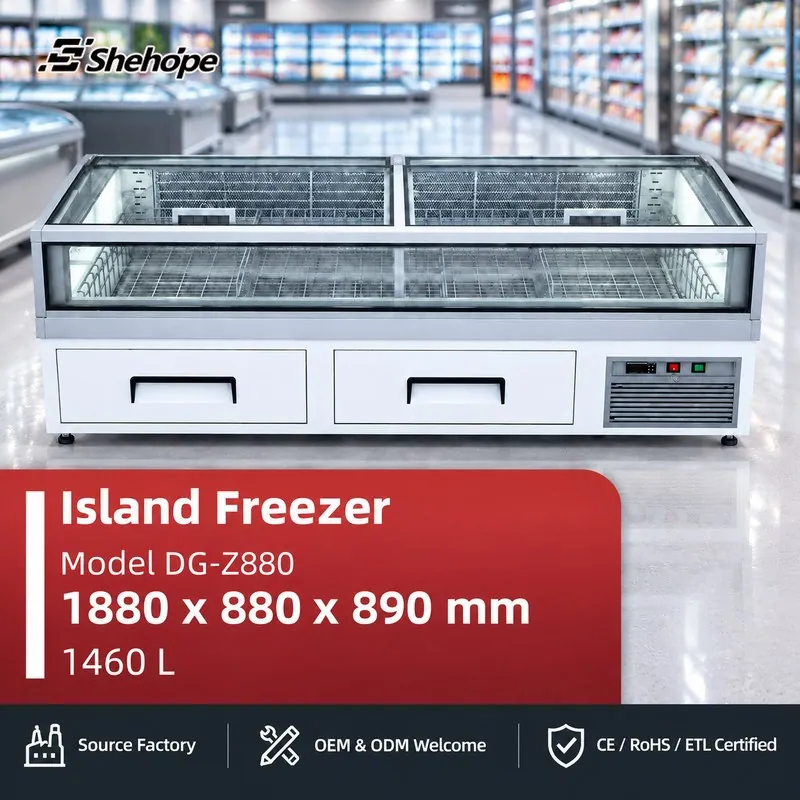
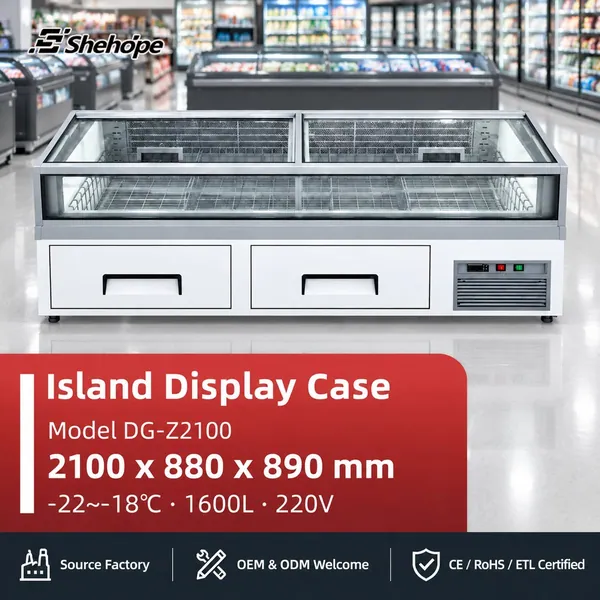
| Widths in this family | 1.88 m, 1.905 m, 2.1 m |
|---|---|
| Door / drawer formats | double door, drawers |
| Catalogue items in this family | 5 (configuration confirmed per project) |
Catalogue items in this family
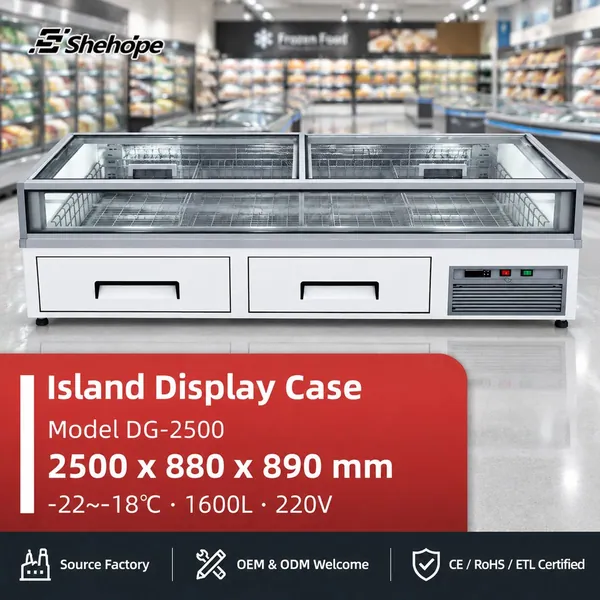
5 catalogue items photographed for this family.
How this family is configured
Run length, straight cabinets and end cabinets
Plan the run before ordering single units, because island cabinets are usually bought as a line rather than one at a time. Straight cabinets make up the run and an end cabinet closes it, so the overall length is the sum of the units plus any gap you want between them. Confirm the aisle width left for shoppers on both sides, since a walk-around display needs circulation space that a wall cabinet does not. Ask how the lids slide and how far they open: on a long run, half-length sliding lids let staff reach either end without walking around. State the length of the run, the height of the surrounding fixtures and whether the cabinets must align with neighbouring display so the aisle reads as one continuous line.
Drawers, baskets and loading pattern
Decide how frozen stock is arranged inside before choosing a model, because drawer and basket layouts change the usable volume and how fast staff can restock. Drawers suit back-up stock kept below the display layer and let staff pull a whole section out to fill it; baskets and dividers suit mixed product that has to stay separated. Confirm the internal depth and how far a person can reach from the side, since a deep chest that is easy to load when empty can be awkward when it is full. Ask how the display layer is supported and whether it lifts out for cleaning. State the product mix and the pack sizes that must stand upright, because that decides the internal height and the divider layout more than the nominal volume does.
Frozen holding, defrost and lid condensation
Island freezers work at frozen temperature, so defrost strategy and lid condensation are part of the specification rather than service details. Ask whether the model defrosts automatically or on a manual cycle, because a manual cycle has to be owned by the store team and worked around trading hours. On a walk-around cabinet the glass lids sit in a cold, humid boundary, so confirm how condensation is controlled: in a warm or humid store, lids that mist over stop customers seeing the display. Ask how melt water and condensate reach a drain or evaporation tray and confirm that the route does not cross the aisle. State the ambient temperature and humidity the store reaches, and whether the cabinets stand near a door or in a draught, because all three change how hard the unit works.
Installation, cleaning and export details
Confirm the power available along the run and whether each cabinet has its own supply or the run is linked, then confirm the plug type for the destination market. Check the floor for level and for the loaded weight, because a full island freezer is heavy and its castors or feet need a surface that will not deflect. Leave clearance for the condensing unit and confirm where it breathes, since cabinets pushed together in a run can starve the condenser of air. Ask which parts lift out for cleaning, how the glass lids are removed, and which cleaning chemicals the gaskets, lid tracks and interior finish tolerate. For export orders, confirm packing type, whether units ship assembled or knocked down, and the document set the destination market requires. Warranty terms and spare parts coverage are confirmed per project.
Questions we ask before quoting
- How long is the frozen run, and how many end cabinets close it?
- How much aisle space is left for shoppers on each side?
- Drawers, baskets, dividers, or a mix, and what pack sizes must stand upright?
- Will the cabinets be linked or does each need its own supply?
- What ambient temperature and humidity does the store reach, and is the position draughty?
- Who runs defrost, and can it be scheduled outside trading hours?
- Which voltage, frequency and plug type does the destination market use?
- How is the glass cleaned, and how are the lids removed for cleaning?
Frequently asked questions
What temperature do island display freezers hold?
Island freezers are built for frozen display, and the exact range is confirmed against the selected model, the product and the store conditions rather than published as one number for the family. Tell us the product, the holding time and the ambient conditions in the store, and the required range is confirmed in the quotation.
Can an island freezer be used as a chiller instead?
No. Frozen display and chilled display use different component sets, defrost strategies and lid design, and a cabinet specified for one duty will not hold the other reliably. If you need chilled walk-around display, describe the application and the appropriate platform is quoted instead.
Why do the glass lids mist up, and how is that avoided?
Lid condensation follows from the temperature difference and the humidity in the store. It is managed through the lid and frame design rather than by a single feature, so state the store humidity and whether the position is near a door or in a draught when you enquire. The suitable configuration is confirmed per project.
Can the length, drawer layout or logo be customized?
Custom work can cover cabinet length, drawer and basket layout, interior finish, and logo marking. Electrical configuration for the destination market can also be handled in an OEM project. Each request is reviewed against the model platform before it is confirmed.
What should be included in an inquiry?
Run length and how the run is closed, aisle width, drawer or basket layout, product mix and pack sizes, store ambient temperature and humidity, voltage and plug type, quantity, and the destination market. A plan of the aisle reduces the number of clarification rounds.
Send the application and we confirm the model
Share the food or product being stored, target temperature, ambient conditions, available space, voltage, quantity and destination market.