
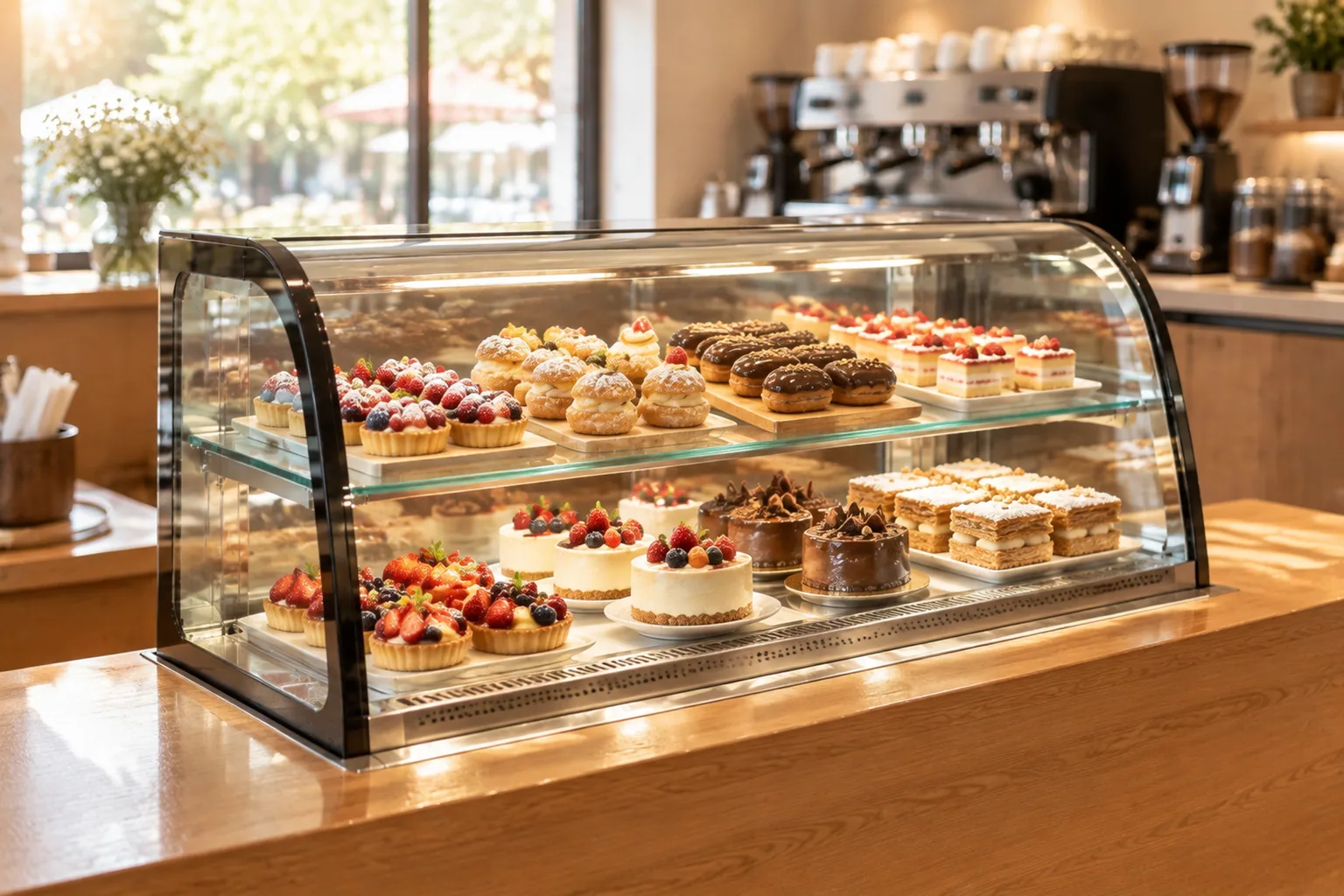
A countertop display case is bought for a counter that already exists. That counter has a depth, a working height, a payment point within sight of the customer and staff who need room to serve, and those limits decide more of the specification than the product list does. This guide covers counter geometry, glass shape, access, shelf pitch, cooling method, ventilation and glass care.
Start with the counter, not the case
The case is the last item in the layout, and the counter sets the limits.
Measure the counter before comparing cabinets. A service counter has a working depth that staff need for the till, trays and cups, and a case that fills it leaves no working surface. One that overhangs the front edge puts load on an edge that was not built to carry it.
Height works in two directions: the top of the case and the product form the customer's eye line, while the lower shelves sit below it. A case that is too tall hides the customer from staff, and one that is too short hides the second and third rows.
Confirm what the counter can carry, and how power and condensate reach the unit, before the counter is built.
- Usable counter depth left after the case is in place
- Case height against the counter and the staff sightline
- Clearance on the loading side for staff and cleaning
- Weight on the counter and how it is supported
- Power supply position and the condensate route
Straight glass or curved glass
Both shapes show product. They differ in footprint and in how quickly they clean up.

Curved front glass wraps the display and softens the hard corner where reflections collect. The trade-off is geometric: the curve occupies depth in front of the shelves, so a curved case can be deeper on the counter than a straight case with the same display depth.
Straight glass gives a predictable rectangular footprint and presents fewer joints to wipe. Reflections from windows, spotlights and the payment screen decide how much of the display a shopper reads at a glance.
Glass configuration and lighting options differ by model, so ask which are available on the platform being quoted rather than assuming that a shape implies a specification.
- Outer footprint compared with usable shelf depth
- Number of glass surfaces, corners and joints to clean
- Access to the inside of the curve for wiping
- Reflections from windows, spotlights and the till screen
- Lighting type and position, confirmed per model
Rear sliding access or front opening
Access follows from who loads the case and who serves from it.
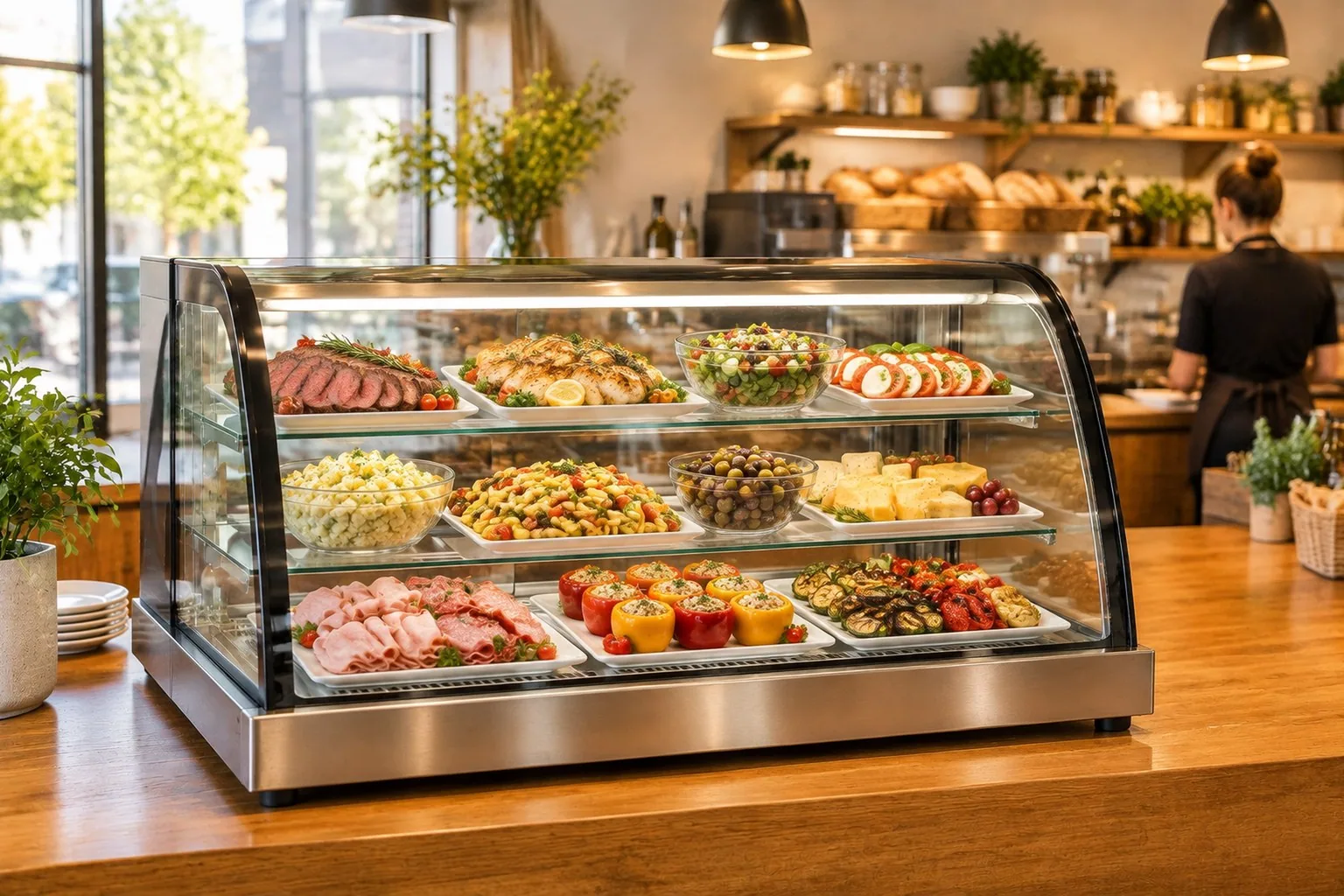
A staff-served counter usually wants rear access, so staff load and rotate stock without walking around to the customer side. Sliding leaves suit a narrow service area because they travel sideways rather than swinging into the aisle, while hinged doors need clear space behind the hinge.
Front opening suits self-service, or a counter where staff also work from the customer side, and it invites customers to reach in. Whichever side opens, look at the track or the hinge: a glass leaf that jumps its track mid-service takes the case out of use.
Ask whether the track and shelves lift out for cleaning, and how the glass is aligned after removal.
- Which side staff load from and where they stand to do it
- Sliding or hinged rear doors and the space each needs
- Front opening, and whether customer reach is wanted
- Removable tracks, shelves and glass for cleaning
- Door locks and what happens to the case after hours
Shelf pitch and the rows a customer sees
In a shallow case the sightline is steep, so row count is set by pitch rather than shelf count.
A countertop case is short compared with a floor-standing unit, so the shopper looks down into it rather than across it. The rows a customer can see depend on the vertical spacing between shelves and the height of each riser, so adding a shelf without changing the pitch hides a row rather than adding one.
Stepped or angled shelves raise the back row so its product faces the shopper, at the cost of display height. Keep product behind the front edge, keep the front row filled during trading, and stay under the load line, because a shallow case has a short return air path to disturb.
- Shelf count and the vertical pitch between shelves
- Riser or step angle and the display height it adds
- Front edge position relative to the glass
- Load line or maximum stack height for the model
Cold well or forced air in a shallow case
The cooling method follows from the product, not from the size of the case.
A cold well cools from below and around the sides by conduction and natural convection. With little air movement, uncovered product loses less moisture, but temperature varies with position and depth and recovery is slower after loading.
Forced air moves cold air through the case, which evens out temperature and recovers faster after a door opening or a loading round. Moving air also dries uncovered product and can lift light packaging, and in a shallow case anything laid across the return grille disturbs it at once.
Confirm defrost type, temperature range and where melt water goes, whether that is a drain or a tray staff empty. All three are confirmed per model.
- Cooling method and the products it suits
- Packaging: wrapped, boxed or open product
- Temperature range for the exact model
- Evenness of temperature across shelves and depth
- Defrost type and condensate handling
Where the case breathes, and what to confirm before ordering
An integral case puts its heat into the room, and the glass in a cafe is touched all day.
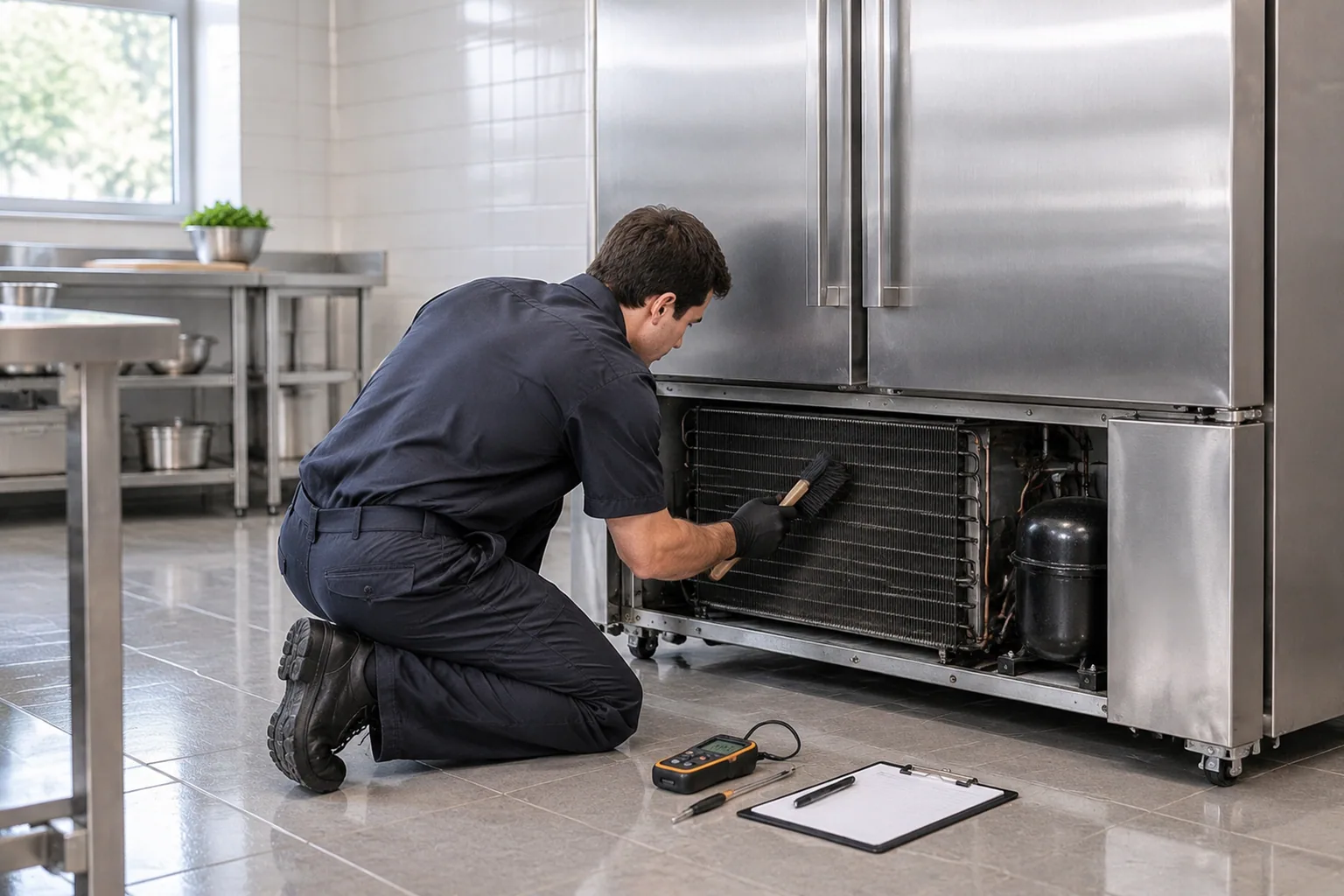
A countertop case with its own condensing unit rejects heat at the rear or through a grille at the base. That air path is part of the specification: the model states clearances, and they are minimums rather than suggestions. A case pushed against a wall, dropped into a closed cabinet or tucked beside an oven works against warmer air.
Measure the air temperature at the position the case will occupy, at the busiest and warmest hour, rather than quoting a room average. Where the counter sits under a window, near a door or beside cooking equipment, that reading is the one that matters.
Glass care is a daily routine in a cafe, not a maintenance task. Choose a geometry that can be wiped in the time actually available, use a cloth and cleaner that suit the glass and any coated or heated option fitted, and avoid abrasive pads. Condensation depends on store humidity and case configuration, and anti-condensation glass is an option rather than a standard.
| Counter limits | Usable depth and height left for the case, what the counter can carry, and the sightline to the customer and the payment point. |
|---|---|
| Format | Straight or curved glass, outer footprint, shelf count and the pitch that gives the rows you want seen. |
| Access | Rear sliding or hinged, front opening, removable tracks and shelves, and loading clearance. |
| Cooling and defrost | Cold well or forced air, temperature range for the exact model, defrost type and condensate handling. |
| Ventilation and ambient | Clearances the model requires, measured air temperature at the case, and what stands beside it. |
| Glass and lighting | Glass configuration, anti-condensation options, lighting type and position, and how the surfaces are cleaned. |
| Electrical and documents | Voltage, phase, frequency and plug type for the destination market, and the compliance documents that apply to that model and market. |
| Production terms | Packing and production planning confirmed per order, and warranty terms confirmed per project. |
- Clearances stated for the model, measured and left free
- Air temperature read at the case position at the warmest hour
- Distance from ovens, fryers, toasters and coffee machines
- A cleaning routine that matches the glass that is fitted
- Compliance documents confirmed per model and market
Send the counter dimensions, the product list, the access side, the air temperature at the counter and the destination market. Those inputs narrow the format before a model is quoted.
SHEHOPE manufactures commercial refrigeration in Foshan, Guangdong, China, inside a shared manufacturing system with more than 20 years of refrigeration manufacturing experience, a 20,000 m² production facility and four production lines. OEM and ODM projects can cover interior layout, shelving and custom logo marking.