
Ultra-Low Temperature Freezers
Deep low-temperature storage for samples, reference material, controls and high-value technical product, in upright and chest formats.
Pharmaceutical and laboratory storage is bought on evidence, not on a headline figure. The buyer has to show where a product, sample or reagent was held, for how long and at what stability, and the equipment only supplies part of that record. Everything the site cannot confirm in writing is a gap in the file.
A cabinet that reaches a low setpoint in a cool room can behave differently in a small, warm room with no air conditioning, and that difference appears as a drift in the record rather than as a failed unit. The second failure is procedural: the site depends on a display reading that nobody transcribes, or on an alarm that only sounds in an empty corridor at night. Neither is a refrigeration fault, and both are discovered during an audit.
The pressures that repeat across laboratories, clinics, pharmacies and research facilities:
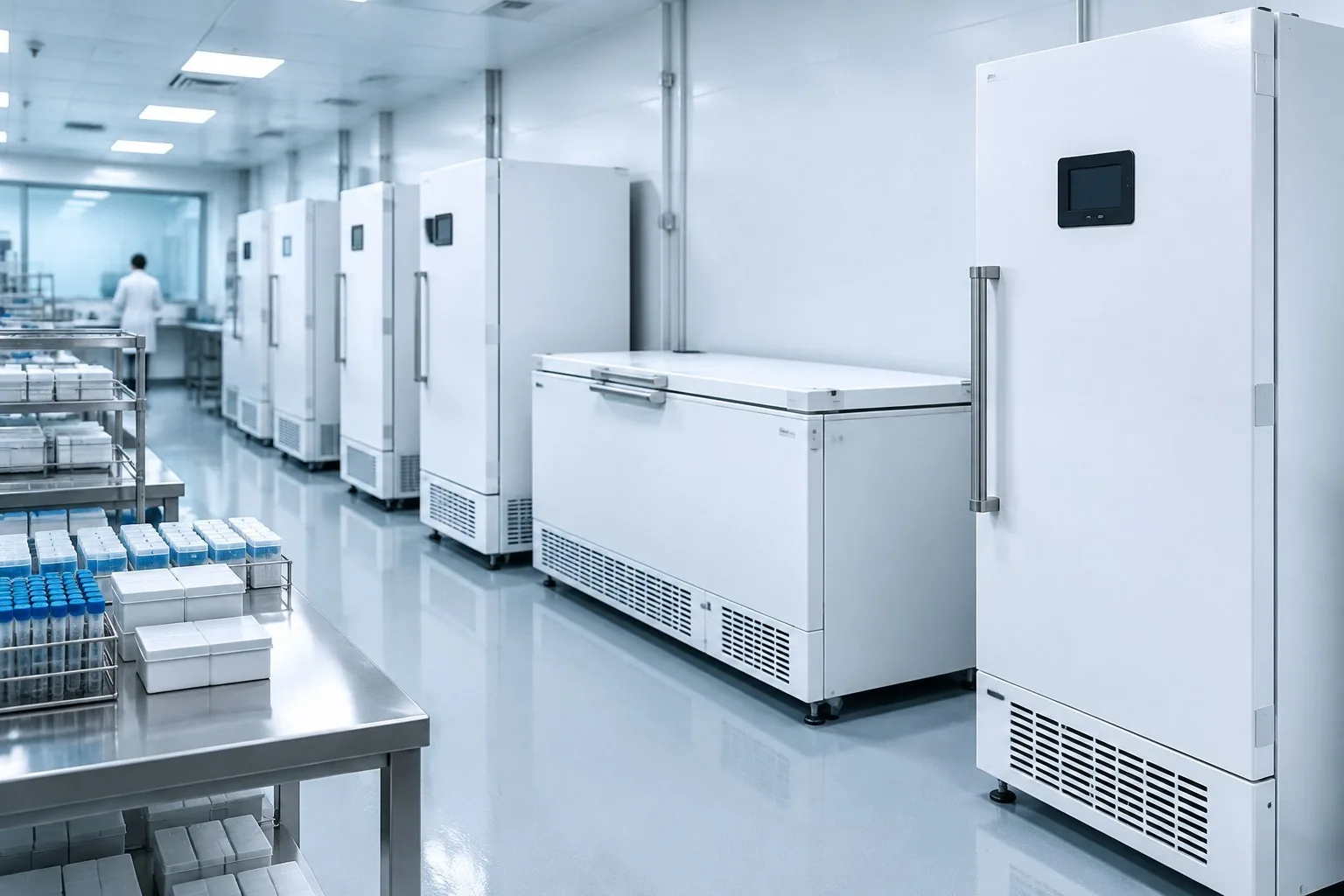
These facilities usually combine several families rather than standardizing on one, because the storage duties sit in different temperature bands:
Deep low-temperature storage for samples, reference material, controls and high-value technical product, in upright and chest formats.
Frozen storage with visible inventory, where staff need to find an item without holding the door open or searching a stack.
Intermediate chilled storage for reagents, media, diluents and cold-chain stock that does not need low-temperature conditions.
Bulk chilled and frozen holding for pharmacies, central stores and processing areas where stock moves in pallets or trolleys.
Rapid freezing of prepared batches, media or process intermediates where the freezing step is part of a defined procedure.
Compact refrigeration at pharmacy counters, dispensing points and small laboratories where the working position has no room for a full-height cabinet.
Refrigerated bench surfaces for handling and preparing material that has to stay in condition while it is worked on.
In technical storage these parameters are the specification. Confirm each one in writing against the exact model under consideration, and keep the confirmation in the project file.
| Required storage condition | Set by the material being stored, together with the tolerance you can accept. The achievable range and its stability are confirmed per model, per ambient condition and per load. |
|---|---|
| Uniformity across the usable chamber | The difference between the coldest and the warmest usable position, at a stated load. Ask how the figure was measured, where, and at what ambient. |
| Recovery after door opening | Time to return to the required condition after a defined opening. In a busy laboratory this drives material condition more than the setpoint does. |
| Format and internal layout | Upright or chest, shelf, rack or drawer arrangement, compartmenting and access height for the people who use it daily. |
| Monitoring and alarm provision | Independent alarm contacts, remote monitoring and data logging availability vary by model and are confirmed per project. |
| Ambient and heat rejection path | The measured temperature and volume of the room, its ventilation, and where the rejected heat goes. All are site facts, confirmed per project. |
| Power supply and interruption plan | Voltage, frequency, phase, circuit protection, dedicated circuit requirement and the site procedure for an interruption. |
| Documentation and service | Datasheet, drawings, electrical data, refrigerant information, manual and spare-parts list, plus the service arrangement. Documentation scope is confirmed per project. |
Send the material or product stored, the required storage condition and tolerance, the holding duration, the expected access frequency, the preferred format, the measured ambient and volume of the room, the heat rejection path, the utilities, the monitoring and alarm requirement, and the destination market with its documentation requirement. Where freezing is part of a procedure, add the batch weight, the entry condition and the process window. State which records the project has to keep, so the available scope can be confirmed early rather than assumed.
SHEHOPE is based in Foshan, Guangdong, China, and works through a shared manufacturing system with more than 20 years of experience, a 20,000 m² production facility, four production lines, an annual capacity of approximately 50,000 units and an ISO 9001 quality system. OEM and ODM projects can cover voltage, plug, interior layout and logo marking, with the final electrical configuration confirmed per model and market. Typical production planning runs 15-30 days, confirmed by model, quantity, season and customization scope, and warranty terms are confirmed per project. For related technical storage planning, see food processing and research and cold storage and distribution. Document scope is explained under certifications and resources.
Deep low-temperature storage for samples, reference material and technical product in upright and chest formats.
Frozen storage with visible inventory, so staff can locate an item without holding the door open.
Intermediate chilled storage for reagents, media and cold-chain stock held above low-temperature conditions.
Bulk chilled and frozen holding for central stores and pharmacies where stock moves in pallets or trolleys.
Rapid freezing of prepared batches or process intermediates where the freezing step follows a defined procedure.
Compact storage at pharmacy counters and dispensing points, where the working position has no room for a full-height cabinet.
Refrigerated bench surfaces for handling and preparing material that has to stay in condition while it is worked on.
A standard commercial freezer holds product at ordinary frozen storage conditions. An ultra-low temperature cabinet works at a deeper setpoint and runs its refrigeration system harder, which changes electrical demand, heat rejection and the room requirements. The choice follows from the material stored and the holding requirement, not from the cabinet size.
The achievable condition depends on the model, the ambient conditions, the product load and how often the cabinet is opened, so it is confirmed against the selected model for your application rather than published as a family figure. Ask for uniformity across the usable chamber and recovery after a defined door opening as well, and how each figure was measured.
Start from the record the site has to keep, then check which parts the equipment can supply. Control and display, alarm contacts, remote monitoring and data logging availability vary by model, and the operator's written routine usually covers what the equipment does not. Confirm both halves before the order, not after installation.
OEM projects can cover market-specific voltage and plug configurations and customized interior layout. The final electrical configuration depends on the model and the applicable market approval, so it is confirmed per project. Whether a dedicated circuit is required is also confirmed per model.
Datasheet, dimension drawings, electrical data, refrigerant information, manual and spare-parts list are the standard set for review. Test records and certificate files depend on the exact model and the destination market, so the documentation scope is confirmed per project before it is relied on.
Send the layout, menu or product mix, target temperatures and site conditions. We reply with the equipment list and the questions that still need answers.