
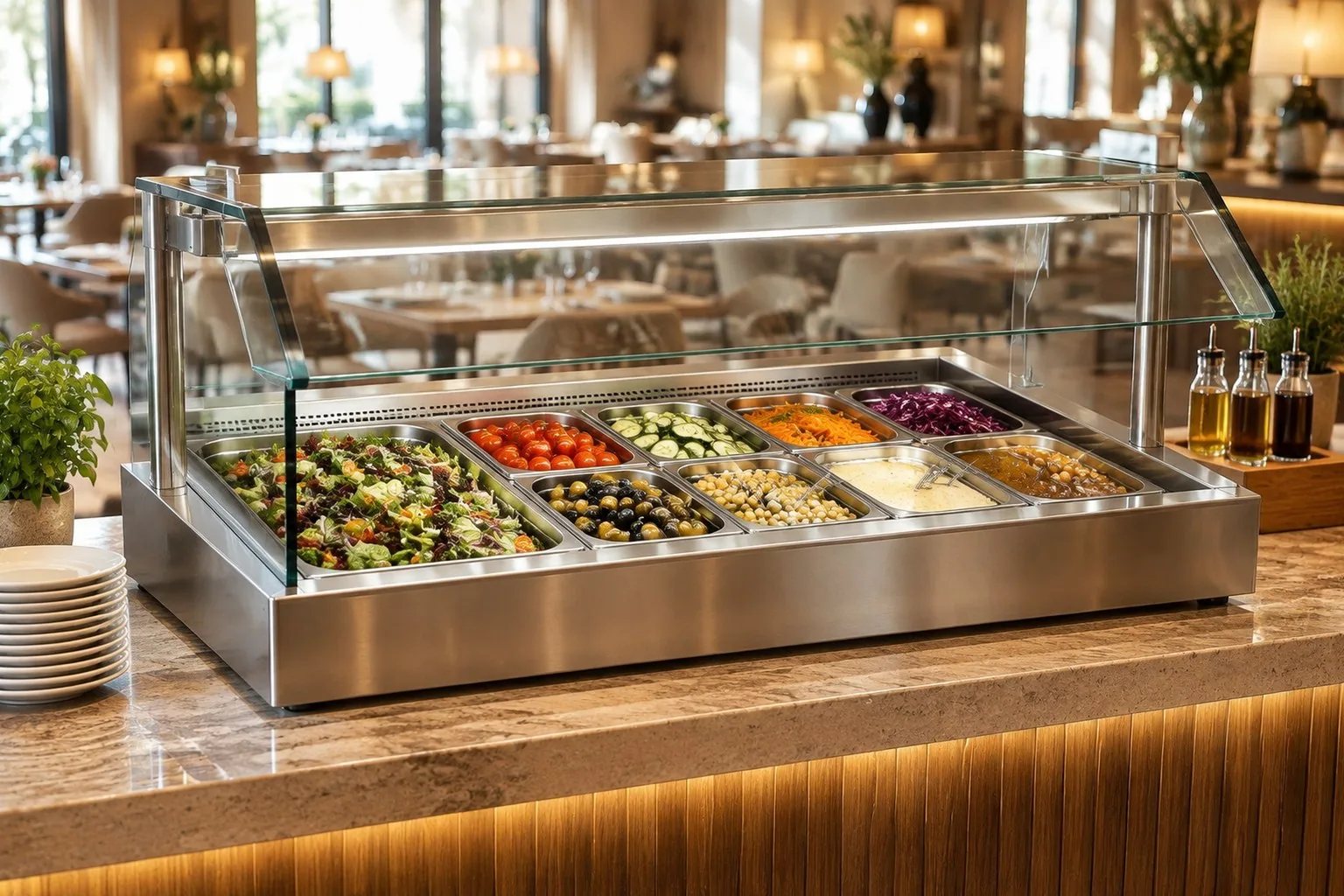
A salad bar is a refrigerated counter that stays open while guests or staff work from it, so it is judged on two things at once: how the food looks and whether it stays cold through a full service. This guide covers the decisions that determine both.
How an open well holds temperature
The well is built to hold cold product, not to chill warm product down.
An open pan well works from contact and from a thin layer of cold air. The pan sits against the well base, so cold transfers directly into the pan, while the evaporator cools the air just below the rim. That cold blanket protects the exposed surface of the food while the bar is open. Because the well is open to the room, the unit always works against ambient air rather than its own sealed cabinet.
The consequence is a rule that decides whether the bar performs: product must go in already cold. A well loaded with warm product at the start of service cannot pull it down fast enough, and it will not catch up while it is open. Mechanically refrigerated wells and ice-filled displays are different products: ice holds a well cold, but the melt rate sets how long it lasts.
Pan layout: start from the grid, not from the pan count
Gastronorm pans come in standard footprints, but the well they sit in does not.

The well is normally a grid sized for GN pan footprints, and the grid divides the well into slots. Work out both numbers together: how the grid divides the footprint, and the pan depth the well accepts. A well specified for one pan family and ordered with another leaves slots that do not close, and gaps around a pan break the contact the base is designed to make.
- Count slots per well, then work back to the ingredient list you serve.
- Check the pan depth the well accepts against the product depth you will display.
- Confirm the bowl, lid or cover options that fit the same grid.
- Decide where the well stops and flat worktop begins, because staff need landing space.
- Ask whether the pan grid can be changed for a project, or is fixed by the platform.
Shallow pans are easier to refill and their product stays closer to the cold base, which is why bars often use several shallow pans rather than fewer deep ones. Deep pans hold more, but the surface of the product sits further from the cold source.
Liquid management and draining
Condensate, spillage and, on ice-filled bars, meltwater all have to leave the counter.
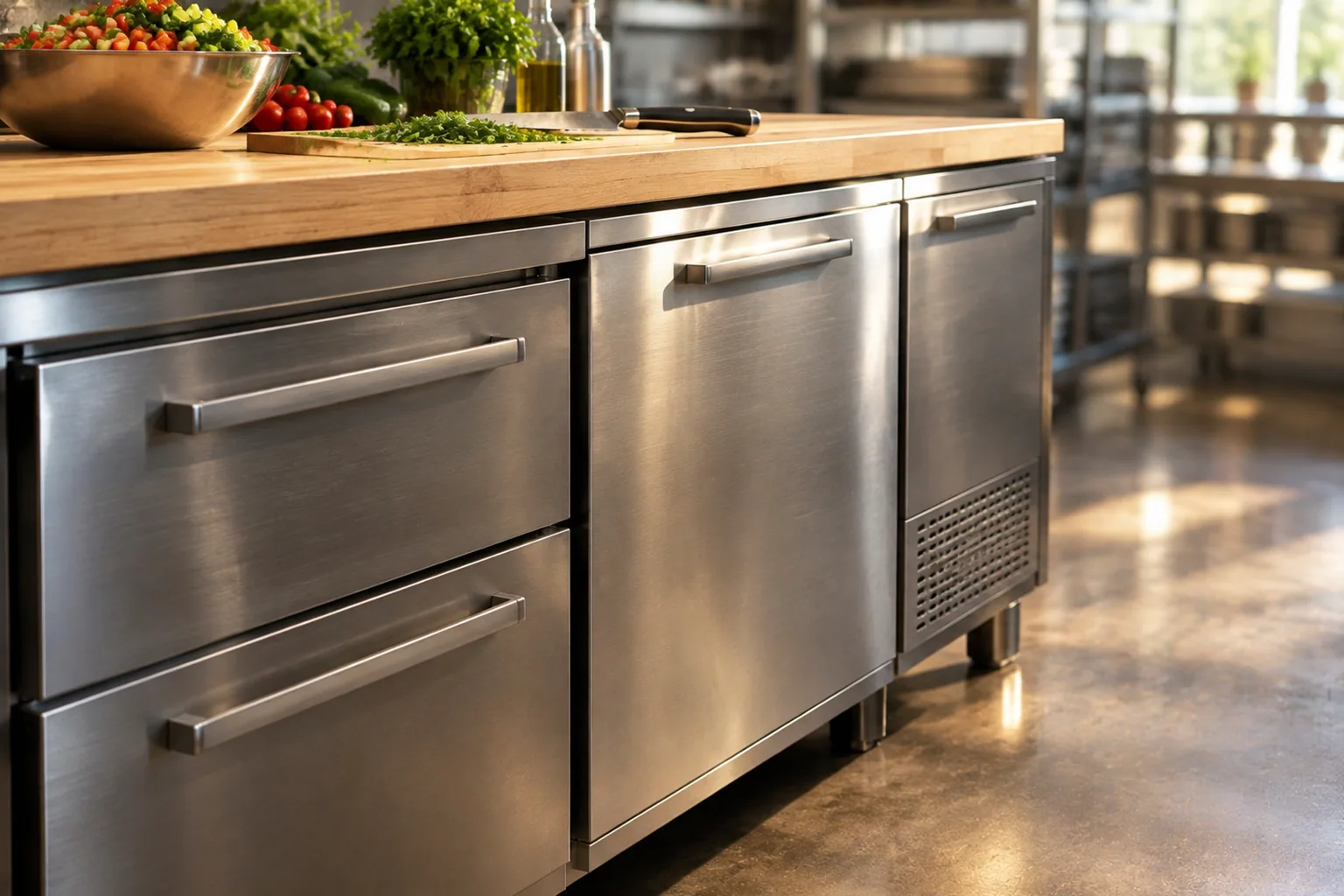
A well collects liquid during service: condensate forms on cold surfaces, and spillage from dressed salads and wet ingredients ends up in the well cavity. The well drains toward a discharge point, so ask where that runs to on the model you are buying, and whether the installation needs a floor drain or a connection into the kitchen drainage.
An ice-filled display adds a much larger water load, because the ice melts throughout service. The cabinet underneath has its own defrost arrangement, which is a separate route. Standing water at the base of a counter is a slip risk and a cleaning problem, and usually an installation fault rather than a refrigeration fault.
Glass guard height for self-service and staff-served lines
The guard is a hygiene item and an access item, and those two roles pull against each other.
A glass guard shields open product from the person serving themselves: breath, coughs, hair and contact with hands. The higher the guard, the better it shields, and the harder it is to reach the pan. The design task is finding the height that satisfies the first requirement without breaking the second, which differs between a self-service bar and a staff-served line.
- Self-service: guards run higher and curve in at the ends, because guests reach from more than one direction.
- Staff-served: the guard is usually lower on the serving side, so one person can work along the line with a scoop or tongs.
- Mixed layouts: a high guard on the guest side and a low or no guard on the staff side.
- Sneezeguard requirements differ by destination market, so the local rule is the starting point.
Pans must sit below the top edge of the guard while the bar is open, so overfilled pans defeat it. Glass that cannot be lifted or swung clear also makes the well slow to clean at the end of service.
Back-up stock below and the ambient the bar stands in
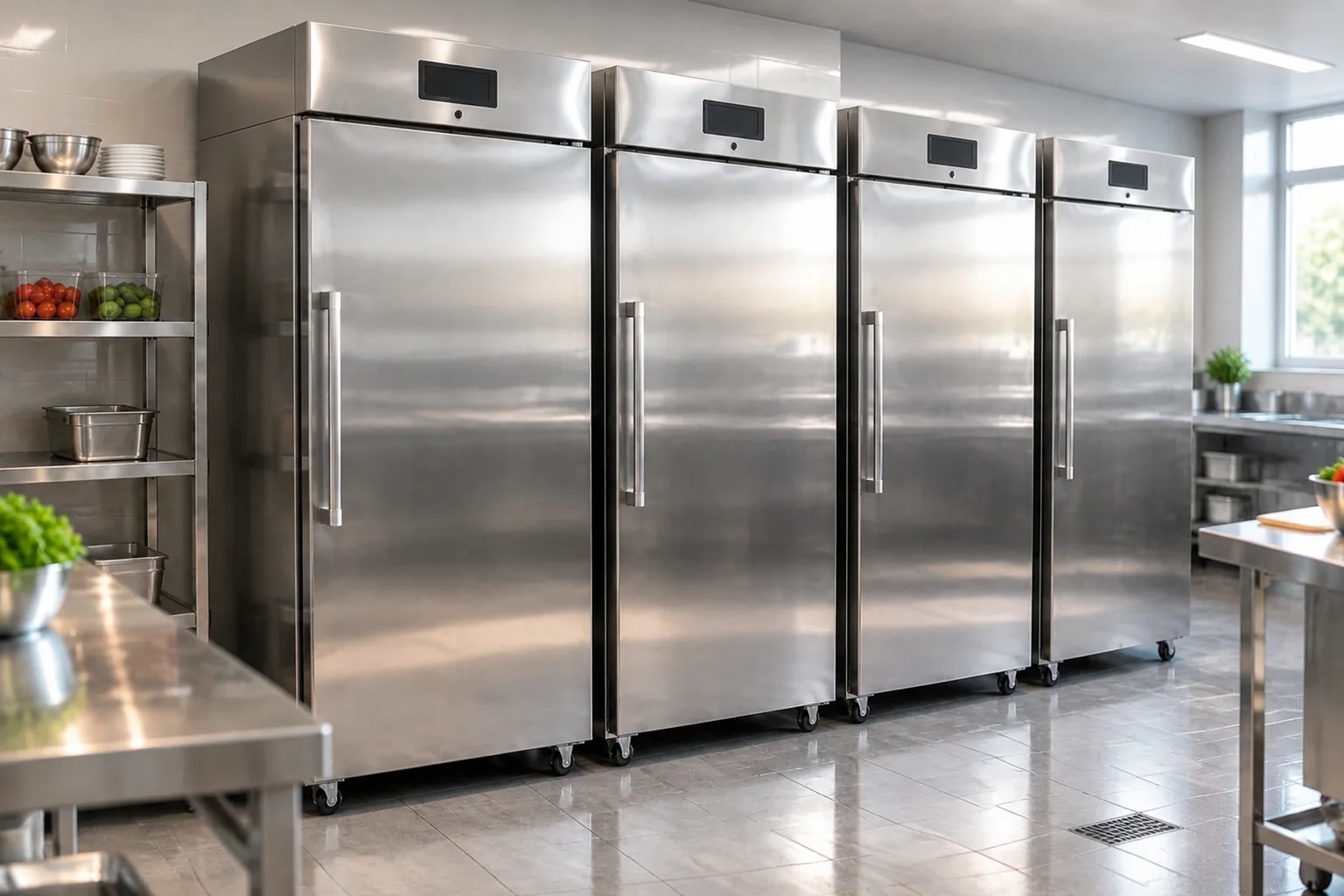
The cabinet under the well is a refrigerator in the busiest position in the room.

The cabinet below a salad bar is nearly always used for back-up stock: replacement pans, spare ingredient trays and the products the bar runs out of during service. That makes it an accessible refrigerator rather than a store, and access decides its performance. A busy bar can be opened dozens of times per hour, so recovery between openings matters more than the steady reading on the controller.
Organize the cabinet to mirror the well layout, so restocking moves straight from cabinet to slot, and keep it clear around the evaporator. If it becomes bulk storage, airflow is blocked and product at the back loses temperature. The usual split is bulk stock in a cold room and one service of back-up stock in the bar.
Ambient conditions decide how hard the bar works. A buffet counter sits next to carving stations, hot food wells, coffee machines and toasters. If the venue runs hot and humid at peak, say so at the inquiry stage and ask about wide-climate configurations; the rated ambient condition is confirmed per project with test data.
What to confirm before ordering a salad bar
Use these parameters as the agenda for the inquiry. Each one is a question, not a fixed value.
| Counter format | Number of wells, straight or curved run, free-standing or built into a counter. |
|---|---|
| Pan system | GN pan footprints the well grid accepts, pan depth, and slots per well. |
| Dimensions | Length, depth and working height, checked against the serving area. |
| Guard type | Guard geometry, whether fixed or removable, and the local sneezeguard rule. |
| Cooling and defrost | Cooling method, defrost type and the drain route for well and cabinet. |
| Cabinet below | Door or drawer sections, shelving and usable volume for back-up stock. |
| Materials | Stainless grade for food-contact and non-contact surfaces, and worktop material. |
| Ambient rating | The room condition the model is rated for, matched to peak buffet-hour temperature. |
| Electrical configuration | Voltage, frequency and plug type for the destination market, per model. |
| Accessories | Castors, locks, pan covers, night lids, guards and spare pan sets. |
| Documents and packing | Datasheet, dimensioned drawing, export packing and the compliance documents applicable to the market. |
Two documents settle most remaining doubt: the model datasheet and a dimensioned drawing. Ask which parameters are fixed by the platform and which can be changed for your project.
Cleaning, routine and the compliance question
Open wells show every lapse, so the daily routine is part of the specification.
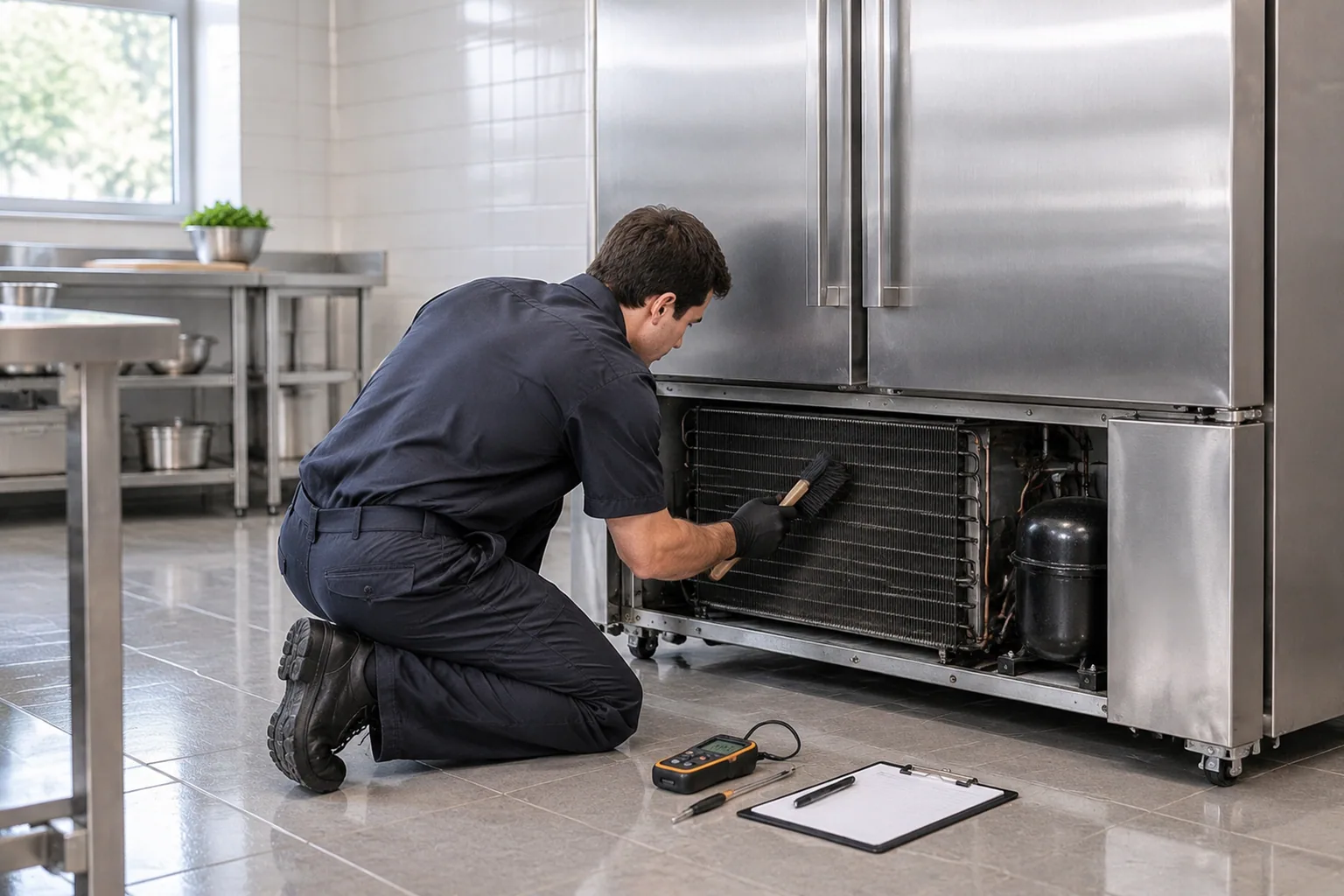
A salad bar is cleaned more often than a closed cabinet because its wells are open during service. Pans, the pan grid and the well surface are washed daily, and the drain is flushed so it does not become a source of odour. Guards need both faces cleaned between services.
Compliance paperwork belongs to a model and a market, not to a catalog. Certificates and declarations are confirmed per model and destination market, so request the documentation that applies to the unit you are buying. SHEHOPE manufactures commercial refrigeration, including salad bars and salad workbenches, in Foshan, Guangdong, China, within a shared manufacturing system with 20 or more years of experience, a 20,000 m2 facility, four production lines and an ISO 9001 quality system.
Frequently asked questions
How often should a salad bar be cleaned?
Pans, the pan grid and the well surface are normally cleaned after each service, and the drain is flushed so it does not hold residue. Guards are cleaned between services because both faces are looked through.
Can a salad bar cool warm ingredients down?
No. An open well holds product that is already cold, using contact with the pan base and a layer of cooled air under the rim. Loading a bar with warm product puts it outside what the design can recover.
Staff-served or self-service: does the guard differ?
Yes. A self-service bar needs a higher guard with curved ends because guests reach from several directions, while a staff-served line uses a lower guard so one person can work along the well. Local sneezeguard rules vary by market.
Where does the water from the well go?
Well condensate and spillage drain toward a discharge point in the counter, and an ice-filled display adds meltwater on top of that. The cabinet below has its own defrost drainage, a separate route, so both are confirmed against the site drainage.
Which documents should we request before ordering?
Ask for the model datasheet, a dimensioned drawing, the accessory list and the compliance documentation applicable to the model and market. Certificate scope differs between models and markets, so the applicable files are confirmed for the unit you are buying.