
Most food-safety plans depend on refrigeration more than on any other single asset, and most refrigeration failures give warning long before they become a food-safety incident. A maintenance checklist turns those early signals into scheduled tasks with a record attached. This guide sets out what to check daily, weekly and periodically, what a monitoring record needs to contain, and what to confirm with a supplier before you buy.
Why refrigeration carries the most risk
It is the control that runs unattended, which is exactly why it needs a routine.
A cold room, prep table or display case holds product at a defined temperature for hours without anyone watching it, so a slow decline is easy to miss. By the time the product temperature is obviously wrong, the safe window may already have passed, and the product at risk is everything in the unit rather than one tray.
That is why food-safety plans treat refrigeration as a control point with monitoring, a defined limit, corrective action and verification. Equipment specification and maintenance routine both feed into whether those records can be produced when an auditor or a customer asks for them.
Daily checks
Fifteen minutes a day covers most of the risk.

Take and record temperatures at the intervals the plan defines, using a calibrated probe or the cabinet display where the plan allows it. Record the reading itself rather than a tick, and note where it was taken: air temperature at the front of a display case and product temperature between packages tell different stories.
During the same walk-round, look at the physical condition of each unit: door gaskets seating correctly, doors closing fully, no standing water or unexpected ice, no unusual noise or vibration, and no new condensation on glass. These observations catch most developing faults before they affect product.
Note anything that needs follow-up and who owns it. An observation without an owner is not a record, it is a note.
Weekly and monthly tasks
Separate what staff can do from what requires a qualified technician.
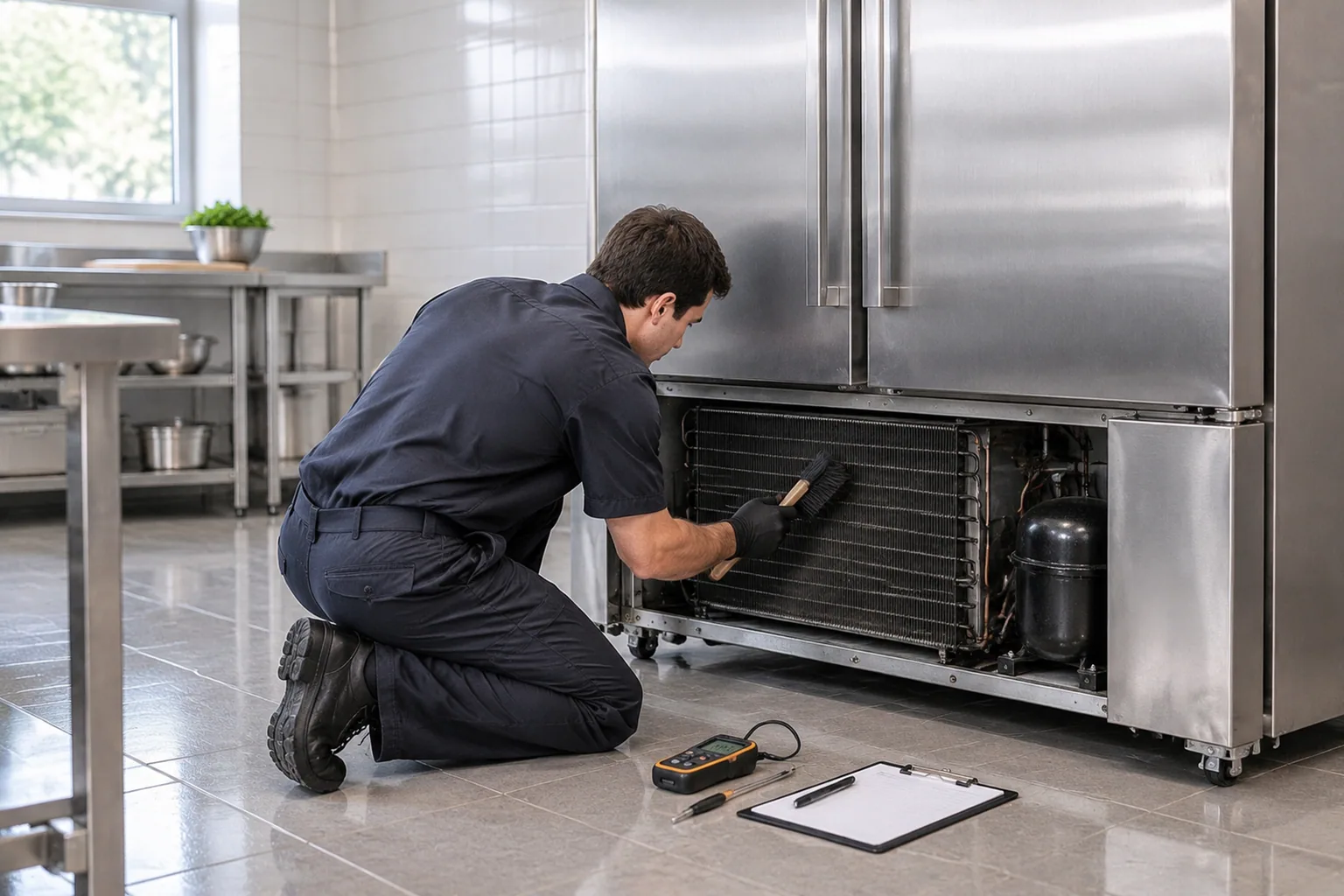
Weekly: clean door gaskets and check them for cracking or compression, clear the air return and discharge grilles, check the condensate drain or tray, and confirm that night covers are being used where they are fitted. Each of these directly affects how well the unit holds temperature.
Monthly: clean the condenser coil, check that shelves and load lines are being respected, inspect hinges and self-closing action, and review the temperature log for trends rather than isolated readings. A unit that runs slowly warmer over several weeks is a maintenance signal even when every individual reading is inside the limit.
Confirm who does each task. Cleaning, loading discipline and daily checks belong to store or kitchen staff. Anything involving the refrigeration circuit, controls or electrical supply belongs to a qualified technician.
Records: what a monitoring log needs
A usable record answers five questions, and the fifth is the one that is usually missing.
The five are: what was measured, where, when, by whom, and what happened when the reading fell outside the limit. Without the last one, the log demonstrates monitoring but not control, and it is the corrective action that a reviewer will look for.
Define the limit and the corrective action in advance, while the unit is working, rather than deciding under pressure. Corrective action usually means checking loading and gaskets, adjusting the unit, calling service, and deciding what happens to the affected product. Record the decision and the outcome for each event.
Retain records for the period your plan and local requirements specify, and keep them easy to retrieve. Digital logs are easier to review for trends, and trend review is where maintenance planning gets its evidence.
What to confirm with a refrigeration supplier
Ask these before the order rather than after the first fault. The answers decide how maintainable the unit will be.
| Model datasheet | Duty and temperature range for the exact model, not the family. |
|---|---|
| Monitoring features | Controller type, display, alarm options and whether remote monitoring is available for the model. |
| Service access | Installation clearances and how the coil, drain and control panel are reached. |
| Cleaning access | Which parts staff can remove and clean without tools, and how the coil is cleaned. |
| Defrost and drainage | Defrost type and where condensate goes in your installation. |
| Wear parts | Availability of gaskets and other consumable parts as spares. |
| Documentation | CE, CB or RoHS documentation as applicable to the model and destination market. |
| Packing and lead time | Export packing and production planning of 20 to 30 days, confirmed per project. |
| Customization scope | Custom logo marking, interior shelving and layout, and market-specific voltage and plug configurations within OEM projects. |
Two answers matter more than the rest for maintenance planning: whether gaskets and other wear parts can be supplied as spares, and how much cleaning access the design provides. Those decide how much of the routine your own staff can carry out and how quickly a fault can be resolved.
When to escalate to a technician
Some signals are routine, and some are not worth waiting on.
Call a technician when temperatures drift outside limits after loading and gasket checks, when a compressor runs continuously, when ice or frost appears where it should not, when water appears on the floor, when a unit trips its circuit protection, or when the controller reports a fault.
Treat loss of function in a cold room, blast freezer or ultra-low temperature unit as urgent, because the volume of product at risk is larger and the recovery time is longer than for a single display case. Have a contingency plan that states where product goes if a unit fails, and test it once so nobody is improvising at the time.
SHEHOPE manufactures commercial refrigeration, including blast freezers, in Foshan, Guangdong, China, within a shared manufacturing system with 20 or more years of experience, a 20,000 m² facility, more than ten production lines, annual capacity of approximately 50,000 units and an ISO 9001 quality system. Export-grade fumigation-free wooden pallet packing is available; final packing depends on product family, quantity, route and customer requirement.
Frequently asked questions
How often should condenser coils be cleaned?
It depends on the environment. A greasy or dusty kitchen loads a coil faster than a clean retail floor, so a monthly clean is a reasonable starting point and the interval should be shortened where conditions are harsh. Ask the supplier for the cleaning guidance that applies to the model.
Does a display reading replace a product temperature check?
No. The display shows the sensor position, which is usually air inside the cabinet, and it will not reveal a warm front row, a blocked air return or product stacked above the load line. Use the display for continuous awareness and a probe for the readings your plan actually requires.
What should a temperature record contain?
What was measured, where, when, by whom, and what was done when a reading fell outside the limit. Defining the limit and the corrective action in advance is what turns a log into evidence of control rather than a list of numbers.
Can kitchen staff do all of this maintenance?
Staff can take daily readings, clean gaskets and grilles, respect load lines and report changes. Anything involving the refrigeration circuit, controls, electrical supply or refrigerant handling requires a qualified technician, and your plan should say where that boundary sits.
What should we confirm before ordering refrigeration?
Confirm the duty and temperature range for the exact model, the monitoring and alarm features, the service and cleaning access, the defrost and drainage arrangement, the availability of wear parts as spares, the documentation applicable to the model and destination market, and the lead time, which is confirmed per project.