
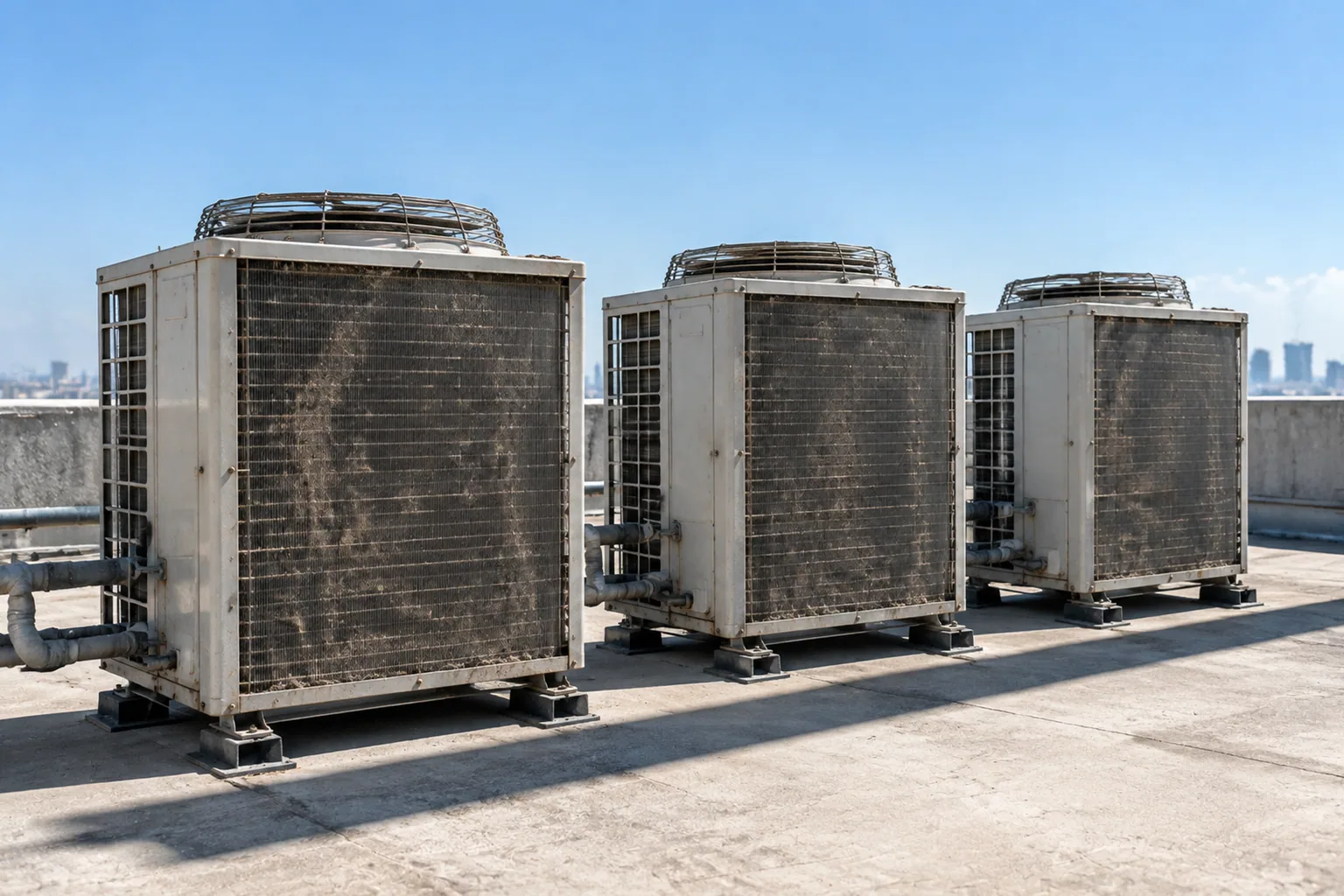
Refrigeration performance is quoted at a stated ambient temperature, and in many markets the kitchen or shop floor spends much of the year above it. Capacity falls, run times rise, defrost becomes more frequent, and a cabinet that looked correctly sized on paper struggles to hold its band. This guide explains what changes at high ambient, what a wide-climate configuration means, and what to confirm with a supplier.
Why ambient temperature changes the whole calculation
The cabinet does not work harder because the air is hot. It works against a harder pressure ratio.
A refrigeration system moves heat from inside the cabinet to the air around it. As the ambient temperature rises, the condensing side has to reject heat into hotter air, which raises the condensing temperature and the pressure ratio the compressor works against. The practical result is a reduction in cooling capacity at the same input, longer run times, and slower recovery after a door opening or a defrost cycle.
Several effects compound. Insulation losses increase because the temperature difference across the panels is larger. Defrost becomes more frequent and takes longer to clear, because warm air holds more moisture. Compressor and fan duty cycles rise, which affects service intervals, and the product band becomes tighter to hold because there is less margin below the upper limit of the zone.
None of this makes the equipment unsuitable. It means selection has to be made at the ambient the site actually experiences, and acceptance criteria have to reflect it. A quotation based on temperate conditions and installed in a hot room is a common source of disputes.
What a tropical or wide-climate configuration means
The label describes a configuration intended for higher ambient conditions, not a performance figure on its own.
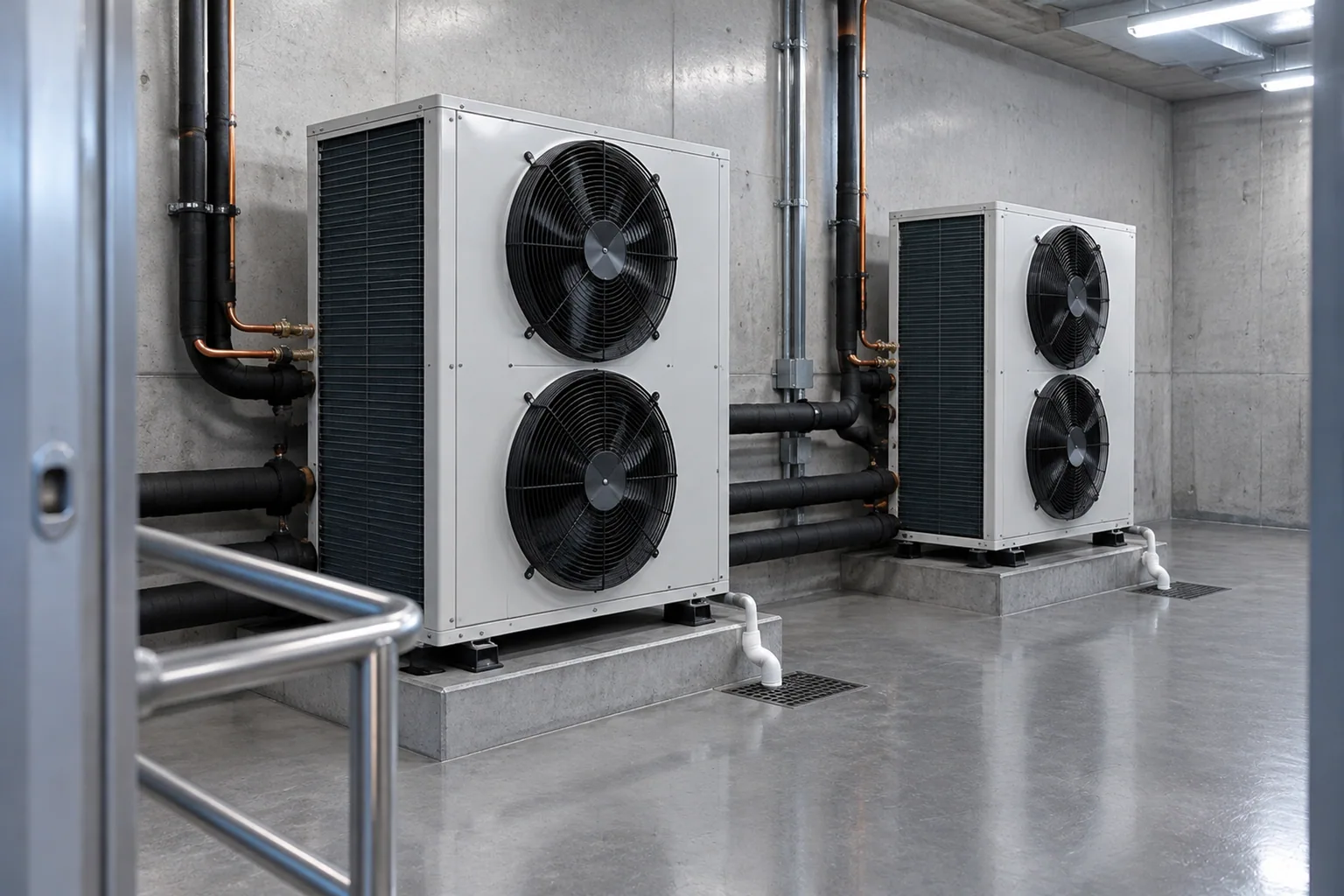
Wide-climate or tropical model configurations are available for high-temperature environments, and they typically differ from standard versions in the components and settings chosen for the higher duty: the refrigeration circuit, the condenser arrangement, the electrical components and the control settings. The exact differences depend on the model and the application, and the rated ambient range for a specific unit has to be confirmed at model level.
That last point is the one buyers skip. A configuration described as tropical does not by itself tell you the ambient it is rated for, the capacity it delivers there, or how long it takes to pull a given load down. Those figures require the model's ambient condition and test data before any performance is quoted.
Use the term as a starting point, then ask for specifics: the rated ambient range, the capacity at your ambient, pull-down and recovery expectations, and which components change. If those answers cannot be given for your conditions, the selection is not finished.
Sizing against the real ambient, not the catalog headline
Size from worst case, then check the consequence of oversizing.
Start by establishing the real ambient: the temperature around the cabinet at the hottest hour of the hottest season, measured where it stands, not a regional average. Kitchen air stratifies, so the ceiling area above a cooking line can be far hotter than the floor, and a unit placed high sees the higher figure.
Then state the duty at that ambient. For a storage cabinet, the duty is holding a band with a stated load and door traffic. For a blast freezer or a pull-down application, the duty is removing a defined amount of heat from a defined product in a defined time, starting from a product temperature, in that ambient. Ask for capacity at the ambient you measured rather than a single headline figure.
Oversizing is not automatically a solution. A larger unit costs more, takes more space and cycles differently against a light load. It is often right in a genuinely hot room, but the decision should come from the load calculation.
Layout, ventilation and heat load
In a hot kitchen, the room is part of the refrigeration system.
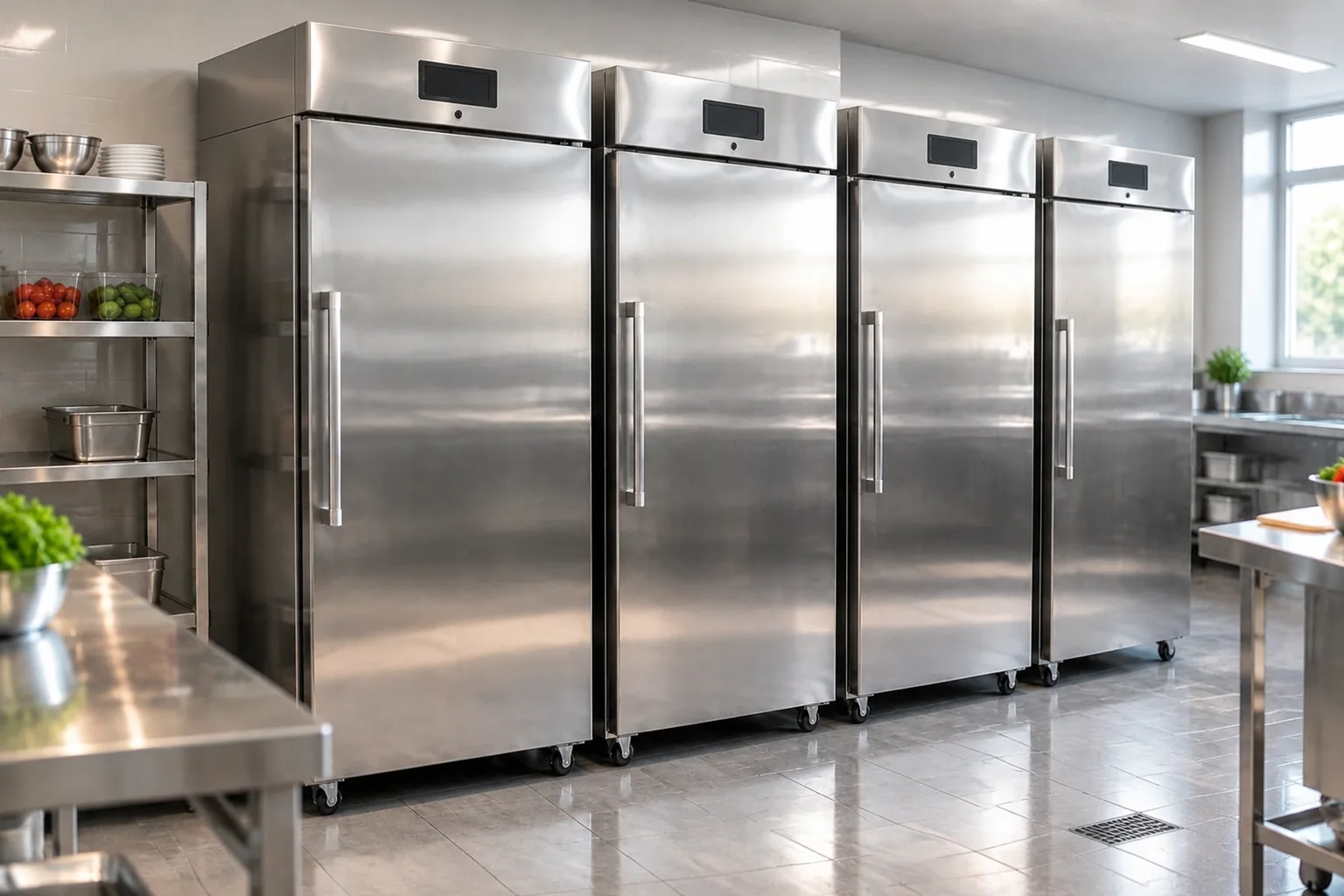
Every cabinet rejects heat into the space around it, and a hot kitchen has to remove both that heat and the heat from cooking. If the space has no ventilation or mechanical cooling, the ambient climbs through the day, and each cabinet's duty rises with it. This is a loop that gets worse over a shift, and it is a layout problem before it is an equipment problem.
Give the condensing unit a clear air path, with the clearances specified for the model, and keep it away from cooking equipment, fryers and dishwashing areas. Avoid enclosed alcoves and cupboards where rejected heat accumulates. Where the unit is remote, confirm the route and length of the refrigerant lines, because those affect the selection as well.
Watch make-up air. A kitchen extracting large volumes through a hood draws replacement air from somewhere, and if it comes through a door or loading bay it will be hot and humid, so cabinet placement along that path is worth deciding deliberately.
Operating practice in a hot site
Some of the lost performance is recovered by how the site is run.
Door discipline matters more at high ambient, because every opening admits hot humid air the evaporator must then remove. Keep openings short, restock in batches rather than item by item, and use strip curtains where the layout allows. Move product in already chilled or frozen where the process permits, since pulling warm product down is far more demanding than holding it.
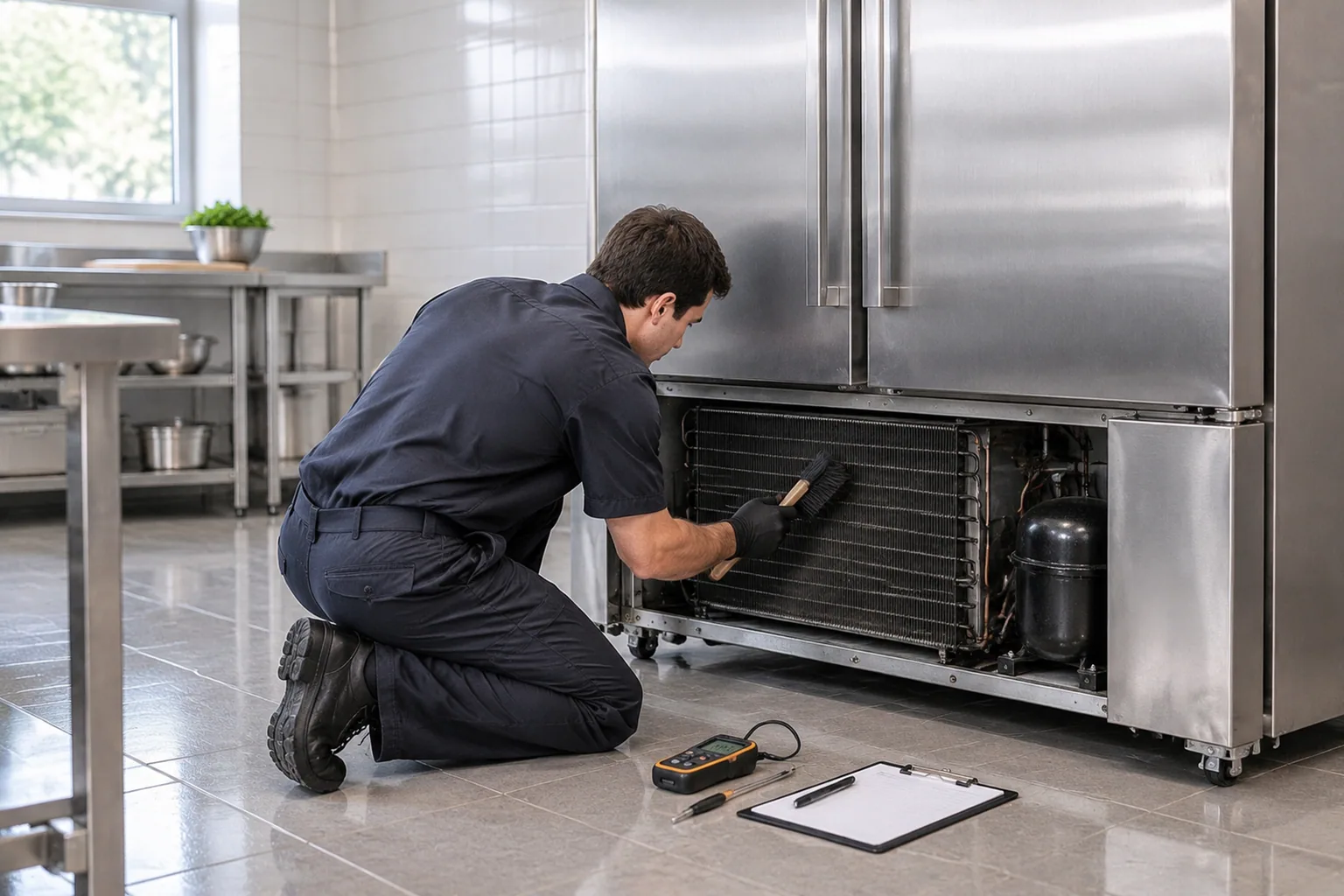
Clean condensers on a schedule. Dust, grease and lint on the coil raise the condensing temperature just as high ambient does, and the two effects add together. Check gaskets and door frames for hardening and ice build-up, and time defrost away from the busiest loading periods.
Monitor the actual band rather than assuming it. A temperature display with an alarm, or a data logger, shows whether the cabinet is keeping up during the hottest hours, which is the only condition that matters for the decision to change equipment.
What to confirm before you buy
Get these answers in writing before the order, especially where the ambient figure is high.
| Real ambient | The temperature around the cabinet at the hottest hour of the hottest season, measured at the installation position, including stratification if the unit is mounted high. |
|---|---|
| Rated ambient range | The ambient range the specific model is rated for, and the capacity it delivers at your ambient rather than at a temperate reference. |
| Configuration | Whether a wide-climate or tropical configuration is available for the model, which components and settings change, and what test data supports the performance quoted. |
| Duty | What the cabinet must do: hold a band with a stated load and door traffic, or pull a defined product load down within a defined time, in that ambient. |
| Placement and ventilation | Clearances around the condensing unit, distance from cooking equipment, air path for rejected heat, make-up air route, and whether the space has mechanical cooling. |
| Electrical and refrigerant | Voltage, phase and frequency for the destination market, and which refrigerant the model uses. Both are confirmed per model and per project. |
| Documentation | CE, CB or RoHS records apply per model and target market. Name the models and the destination country and ask for the matching file set, plus the specification sheet and manual. |
| Commercial terms | Typical production lead time is 20 to 30 days and is confirmed by model, quantity, season and customization scope. Warranty terms are confirmed per project, and export packing can be agreed by product family, quantity and route. |
SHEHOPE supplies refrigeration for high ambient sites inside a shared manufacturing system with more than 20 years of refrigeration manufacturing experience, a 20,000 m² production facility, more than ten production lines and an ISO 9001 quality system. Panels use high-pressure polyurethane integral foaming for insulation, sheet-metal parts are cut on precision CNC laser equipment, and units are assembled on a standardized production line. OEM and ODM projects can cover 3D CAD design and development, custom logo marking, interior shelving and layout changes, and market-specific voltage and plug configurations.
Send the measured ambient, the duty, the placement and the destination market with your inquiry. Those four inputs decide whether a standard configuration is adequate or whether a wide-climate build is needed.